
By: J.J. Pavlick | Uniondale, NY | June 19, 2026 |
UNIONDALE, N.Y. — The New York Atlas spent nearly the entire night chasing the Boston Cannons. They turned the ball over, trailed through three quarters, and leaned heavily on their goalie just to stay afloat. But with the game hanging in the balance, they delivered the one moment that mattered with a late 2‑point strike that gave them their first lead and sealed a dramatic win Friday night at James M. Shuart Stadium.
The victory came on a night when the Atlas received their 2025 championship rings and watched their title banner rise in the stands, a Long Island homecoming that carried weight for several players and their head coach. The pregame ceremony stretched longer than usual, the crowd lingered on every introduction, and the atmosphere felt more like a reunion than a routine league game.
“It really felt like a home game for us,” said Atlas goalie Liam Entenmann, a Point Lookout native and Chaminade graduate who finished with 17 saves. “I grew up coming to games here. To win one like this on Long Island means a lot.”
For Entenmann and several teammates with local ties, the night carried a sense of return not just to a familiar venue, but to the version of the Atlas they expected it to be. After three straight losses, a slow start, and a first half defined by turnovers, the team needed a performance that reestablished its identity. The ring ceremony provided the reminder; the comeback provided the response.
Cannons Control Early, Atlas Survives on Entenmann’s Back
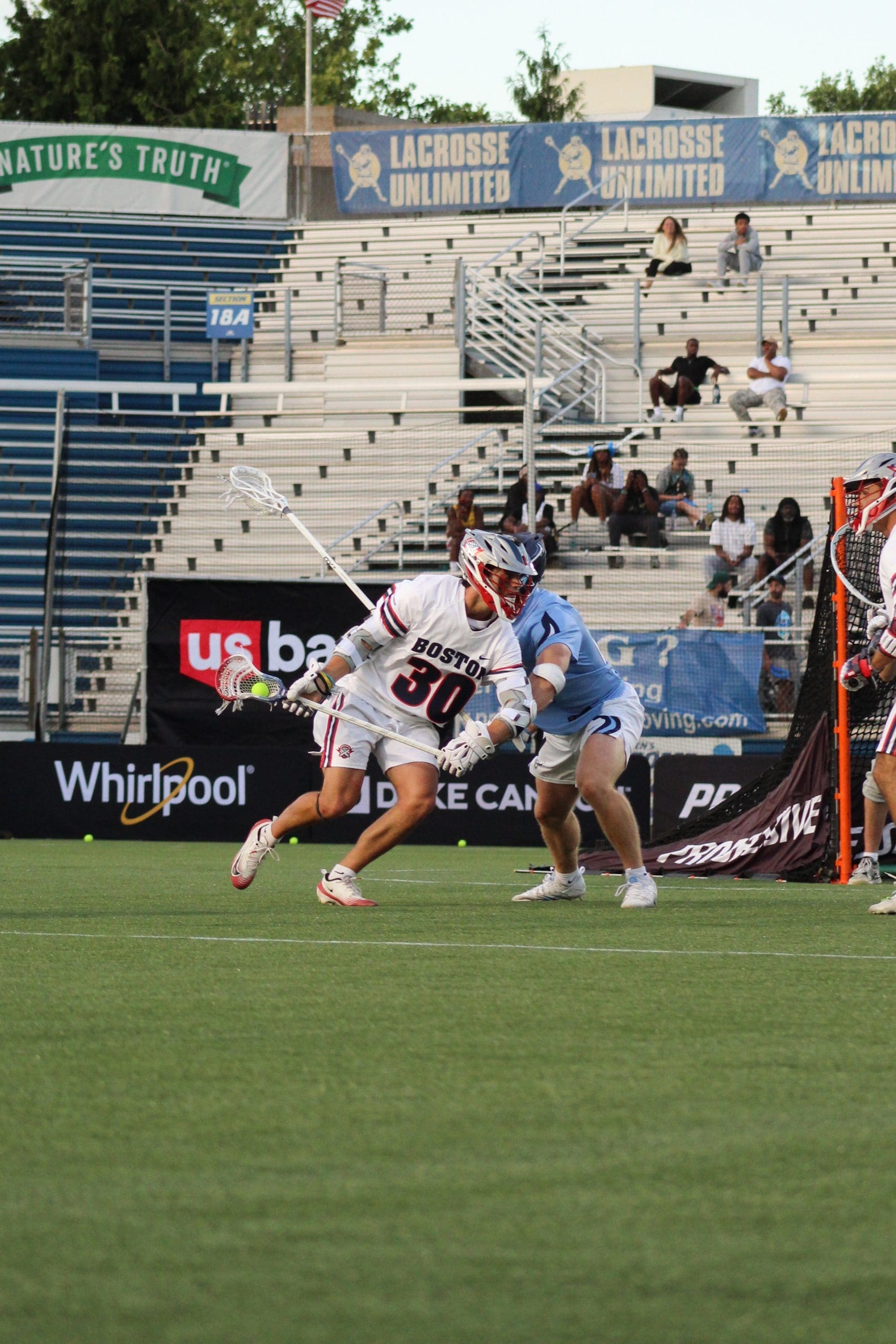
Boston dictated the opening half, capitalizing on New York turnovers and dominating possession. Marcus Holman scored 13 seconds into the game, and the Cannons kept the pressure on, forcing Entenmann into a heavy workload. Boston fired more than 50 shots by night’s end, and Entenmann repeatedly bailed out the Atlas during long defensive stretches.
“When a team shoots that much, you get tired pretty quickly,” Entenmann said. “But you just hit the reset button and make the next play.”
New York’s offense sputtered early, committing turnovers on its first four possessions. Boston built a multi-goal cushion behind finishes from Matt Traynor, Mic Kelly, and Mikey Weisshaar, while the Atlas struggled to generate clean looks.
The momentum finally shifted late in the second quarter when faceoff specialist Nathan Laliberte won a draw clean and scored five seconds later, cutting the deficit and giving New York its first real spark.
Third Quarter: Cannons’ Youth Movement Shows Up
Boston continued to dictate tempo in the third quarter. Regnery scored at 3:07, and Traynor added another moment later. New York answered with goals from Hugh Kelleher and Xander Dickson, but the Cannons kept pushing, with Mic Kelly and Graydon Hogg extending the lead.
Cannons head coach Brian Holman, who previously coached at Johns Hopkins, North Carolina, and Utah, said he was encouraged by the performance of his young roster.
“We ran a lot of young bucks out there tonight,” Holman said. “Thirteen guys who’ve been with us one or two years. I was really encouraged by the improvement. We battled every inch of the way.”
Cannons midfielder Connor Kirst, a Rutgers graduate from Bernardsville, N.J., said the crowd fueled both teams.
“It was loud toward the end,” Kirst said. “Credit to the fans on the island. It made it a lot of fun to play.”
For Boston, the quarter represented more than a temporary surge; it was a snapshot of what the franchise is trying to build. With veterans like Holman and Marcus Holman anchoring the offense and a wave of first‑ and second‑year players taking on expanded roles, the Cannons leaned into their youth and played with a confidence that belied their inexperience. They pushed pace, won ground balls, and generated over 50 shots by night’s end, a volume that reflected both their aggression and their belief that they could out‑run and out‑shoot the defending champions.
Even as the Atlas began to settle in, Boston’s young core kept the pressure on, forcing New York to match their energy and setting the stage for a fourth quarter that would swing on a handful of plays and, ultimately, one decisive shot.
Fourth Quarter: Shellenberger, Kelleher, and Costabile Flip the Game
The Atlas finally broke through in the fourth. Dickson scored off a feed from Connor Shellenberger at 2:28, and G. Hogg tied the game moments later. New York then survived a man‑down situation after a penalty on Michael Rexrode.
Boston regained the lead with goals from Traynor and Holman, but New York refused to fold. At 10:49, Shellenberger scored off a setup from Dickson to tie the game again.
Then came the moment the crowd had been waiting for: with under two minutes left, Brett Makar forced a turnover, pushed transition, and found Bryan Costabile above the arc. Costabile stepped into space and ripped a 2‑pointer that beat the Cannons’ defense and sent the stadium into a roar.
It was the Atlas’s first lead of the night and the one that sealed the win for the Atlas, who improved to 2-3 on the season.
“Just a Division I gut shot,” Atlas head coach Mike Pressler said. “These guys wanted it so badly. Coming off three straight losses, we needed this.”
But the play was more than a momentum swing; it was a release. For a team that had spent three weeks searching for rhythm, for a roster stretched by injuries and lineup changes, and for a group that had been outshot, out‑possessed, and out‑executed for most of the night, the 2‑pointer represented a return to form. It was the kind of shot that defined last year’s championship run: opportunistic, fearless, and delivered by a veteran who thrives in pressure moments.
The Atlas closed out the final possessions with composure, leaning on Entenmann’s poise and a defense that finally settled into its structure. By the time the horn sounded, the comeback felt less like a steal and more like a statement, a reminder that even on an uneven night, the defending champions still know how to finish.
A Homecoming for Long Island Natives
For Entenmann and Kelleher, the night carried a weight that went beyond the scoreboard. Both grew up on Long Island fields, both spent their childhoods watching games at Hofstra, and both understood exactly what it meant to walk into Shuart Stadium wearing “New York” across their chests.
Kelleher, the Cornell midfielder from Wantagh and a MacArthur High School product, delivered the best performance of his young pro career — a hat trick built on downhill dodges and decisive reads. The Cannons gave him space early, and he punished them for it.
“My teammates created space for me,” he said. “They weren’t sliding much, so I could get downhill and get good shots.” It wasn’t bravado—it was the voice of a local kid who had waited his whole life for a night like this and then rose to meet it.
Entenmann, meanwhile, stood in the same crease he once watched from the stands as a kid from Point Lookout and Chaminade. Now he was the one the crowd roared for, the one anchoring a defense that needed every one of his 17 saves to stay alive.
“It’s a pinch‑me moment,” he said. “I watched legends play here. To wear “New York” across my chest in this stadium—it’s special.” His performance matched the sentiment. He didn’t just steady the atlases—he kept them breathing.
Head coach Mike Pressler, who has coached everywhere from Army to Duke to Bryant, understood the significance of the setting as well as anyone. He’s coached in Final Fours, rivalry games, and championship moments, but Friday night carried a different kind of resonance.
“Hofstra is one of the most iconic venues in the sport,” he said. “With so many New Yorkers on our roster, it truly felt like a home game.”
And it wasn’t just nostalgia. It was identity. The Atlas needed a win to stop a three‑game slide. They needed a performance that reconnected them to the team they were last summer. They needed their Long Island core to lead them back.
On a night when the rings came out, the banner rose, and the crowd leaned in, they got exactly that — not just from the stars, but from the players who grew up dreaming on these fields.
A Moment Bigger Than Lacrosse: The Atlas’ Meeting With Wantagh’s Jack Hayes
Before the game, the Atlas gathered in a quiet hallway beneath the stands to meet 11‑year‑old Wantagh goalie Jack Hayes, a kid who should’ve been spending his summer tracking shots and chasing ground balls, not fighting leukemia. He walked in wearing his jersey, a little shy at first, but with the same posture every goalie learns early — shoulders squared, chin up, ready for whatever comes next.
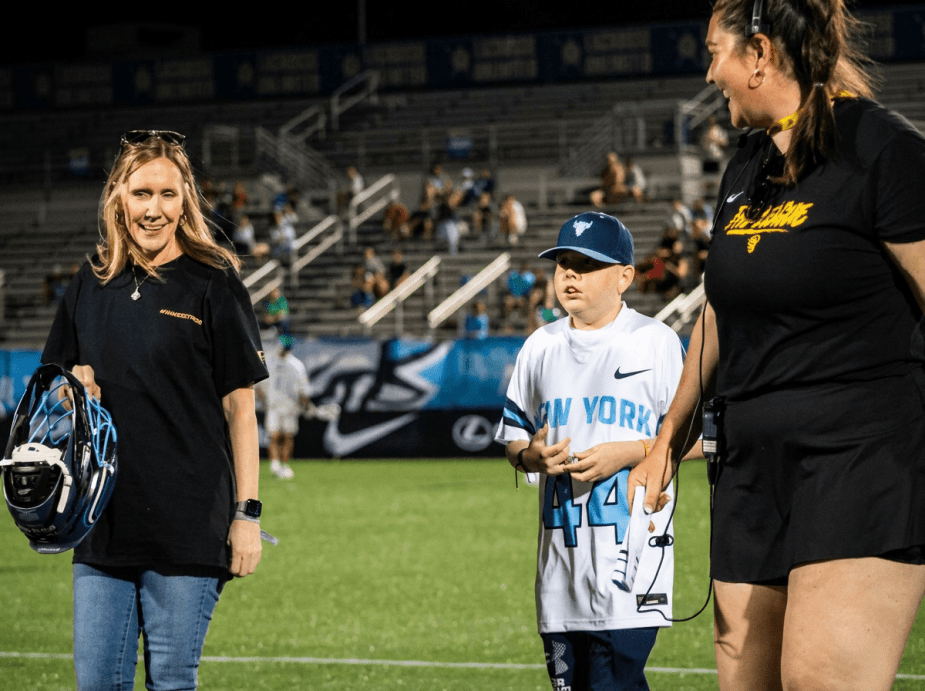
His story has traveled fast across Long Island. The leg pain that wouldn’t go away. The hospital visits. The bloodwork that came back “off the charts.” The diagnosis that hit his family like a freight train. The chemo port in his chest that means no contact sports for two years. The Wantagh varsity team naming him a captain. The community raising more than $130,000 to help his family shoulder the weight.
The Atlas knew the broad strokes. What they didn’t know until they saw him was the steadiness he carried, a Long Island kid fighting a battle far bigger than lacrosse, standing there with a calm that didn’t match his diagnosis and a presence that filled the room before he said a word.
In Their Own Words
For Liam Entenmann, a Long Island goalie himself, the moment cut deeper than he expected.
“It’s one of the most rewarding experiences of my life,” he said later. “You meet a kid fighting for his life with a smile on his face — it makes you ask what excuse you have not to give everything.”
New York Atlas Goalkeeper, Liam Entenmann
Entenmann shook Jack’s hand, talked goalie‑to‑goalie, and saw in him the same competitive spark he once had at that age. Except Jack’s fight is different. His opponent isn’t a shooter at 12 yards, it’s something no kid should ever have to face.
Head coach Mike Pressler stood back at first, letting the players connect with Jack. But when he finally stepped forward, the moment hit him hard. Pressler has coached in national championships, coached through controversy, coached through the kind of public firestorm that reshapes a life. But this was different.
“We play a silly game with a rubber ball,” he said. “Jack is fighting a real battle. I’m in that kid’s corner for life.”
New York Atlas Head coach Mike Pressler
Pressler wasn’t performing for the cameras. There weren’t any. He meant it, asking for the family’s number. Telling them he wanted to stay in touch, not as a coach, but as a man who understood what it meant to have your world turned upside down.
For the Atlas, the meeting didn’t serve as motivation or a rallying cry. It was perspective. A reminder that the pressure of a three‑game losing streak isn’t pressure at all. That a slow start or a turnover‑heavy half isn’t adversity. That the real fight was standing in front of them, smiling, trying to be brave in a way no athlete ever has to be.
When the Atlas walked onto the field minutes later, the ring ceremony still fresh, the crowd buzzing, and the Cannons waiting, they carried Jack with them — not as a symbol, but as a kid they’d just met, a kid they wanted to honor by playing the kind of game he deserved to see.
And when the final horn sounded, when the comeback was complete, when the stadium erupted, the Atlas didn’t talk about the 2‑pointer or the defensive stands or the momentum swings.
They talked about Jack. Because some nights, the story is bigger than the score. As Pressler put it, this is just a game played with a silly rubber ball. Jack Hayes is fighting for his life a battle no child should ever have to face.
A Needed Win Before a Quick Turnaround
For all the emotion wrapped into the night — the rings, the banner, the homecoming, the comeback — the Atlas didn’t have long to savor any of it. The win snapped a three‑game slide, but it also marked only the first half of a demanding weekend. Less than 24 hours after walking off the field, they would be back under the lights to face the Whipsnakes, a team that punishes slow starts and thrives on short‑rest matchups.
“We came here to get two,” Pressler said. “Celebrate this one for ten minutes, then flush it. We’ve got work to do.”
The message wasn’t bravado. It was necessity. The Atlas emptied the tank to claw back against Boston — leaning on Entenmann’s 17 saves, Kelleher’s hat trick, Shellenberger’s fourth‑quarter surge, and Costabile’s late heroics. They played from behind for nearly 48 minutes, absorbed more than 50 shots. Surviving penalties, turnovers, and a night where the Cannons’ young core pushed them to the edge.
Now they have to reset, recover, and prepare for a Whipsnakes team waiting with fresh legs tomorrow.
The Atlas walked off the field knowing they had rediscovered something — their edge, their identity, their ability to close. But they also knew the standard doesn’t pause for sentiment. Not in this league, on a doubleheader weekend. When the defending champions are trying to climb back to who they were.
Friday night was a reminder of what the Atlas can be. Saturday night will be a test whether they can sustain it.
Discover more from Bad Dawg Media Group
Subscribe to get the latest posts sent to your email.