


By: J.J. Pavlick | West Point, NY | October 6, 2026 |
KAISERSLAUTERN, Germany — Battlefield medical setups are stepping out from under the canvas and hitting the road. In a significant leap forward for frontline military medicine, soldiers with the 30th Medical Brigade are testing a prototype M1087 expandable van to transform traditional, stationary field surgeries into rapid, highly mobile, and more survivable medical platforms tailored for large-scale combat operations.
The initiative, spearheaded by the 67th Forward Resuscitative Surgical Detachment (FRSD), replaces cumbersome, tent-based configurations with an agile wheeled alternative. The prototype empowers frontline surgical teams to achieve operational capability more quickly and to deploy at a moment’s notice as battle lines shift.
Slashing Setup Times to Minutes
The shift from fabric structures to an expandable vehicle body addresses the United States Army’s critical need for speed. Under traditional protocols, medical units must fully erect canvas tents before a surgical suite can be assembled inside, costing invaluable time during the “golden hour” of trauma care.
The M1087 radically alters that timeline. Teams can drive the vehicle directly into position, expand its sidewalls, and establish an operational theater concurrently while the rest of the detachment sets up peripheral operations.
“The prototype reduces setup time from approximately two hours to about 30 minutes and enables the team to displace in approximately 15 to 20 minutes,” said U.S. Army Maj. Nicholas Cylus, chief of clinical readiness for the 519th Hospital Center and a certified registered nurse anesthetist. “The platform also features two operating room beds and provides the team greater self-reliance.”
According to Cylus, the rapid deployment capability positions the 30th Medical Brigade at the absolute vanguard of innovation in modern Army medicine.
Tactical Survivability: Hiding in Plain Sight
Beyond mere speed, the platform answers critical safety issues associated with contemporary combat. Large, stationary medical tents create massive physical and thermal footprints, making them easy targets for modern enemy surveillance and long-range precision strikes.
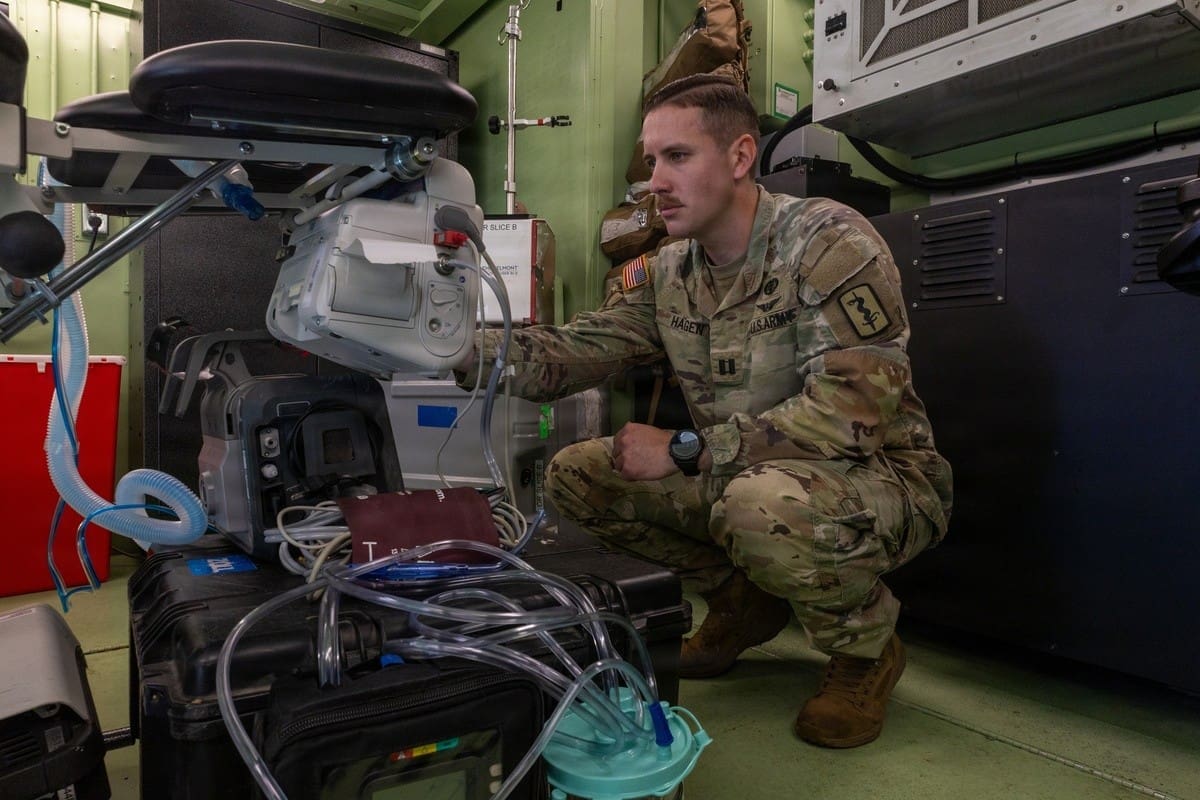
The compact profile of the M1087 allows medical teams to mask their location far more efficiently. U.S. Army Capt. Josh Hagen, a critical care nurse with the 67th FRSD, noted that during the recent Saber Junction training exercise, the unit utilized the vehicle’s compact footprint to hide in plain sight, successfully keeping personnel safe while simulated enemy forces maneuvered completely around their position.
“The 1087 definitely helps us move faster,” Hagen said. “It is a quicker teardown, a quicker setup. It allows us to maneuver into positions that we haven’t been able to before.”
Inside the vehicle, the layout is meticulously engineered around motion. The interior features wheeled medical gear secured by heavy-duty locking systems. To pack up, soldiers roll the equipment toward the center axis, strap it down, lock the storage systems, and collapse the van walls.
Decentralized Command and Strategic Self-Reliance
The mobile framework grants theater commanders immense flexibility. Rather than tethering maneuver elements to centralized field hospitals, commanders can disperse damage-control, resuscitative, and surgical assets across the entire area of operations.
“We’ve got to continue to adapt to how we fight, how we maneuver, and how we protect ourselves,” said U.S. Army Col. Nate Forrester, commander of the 30th Medical Brigade. “That’s exactly what the M1087 is going to be doing for us.”
The system is built to sustain itself independently near the front lines. The van features built-in electrical generation and can run silently on internal battery power for roughly 9 hours before needing a recharge. While operating in its confined footprint, the mobile suite can support one active surgical patient and hold up to two casualties simultaneously.
The standard detachment consists of 20 personnel and can splinter into two 10-person teams. The M1087 equips one of those sub-teams with a completely autonomous, nomadic surgical asset.
Improving the Foxhole for the Future Force
The 30th Medical Brigade treats the current prototype as an active laboratory, gathering real-time telemetry and user feedback to refine future variations. Forrester indicated that the ultimate long-term roadmap could include integrating six specialized M1087 vehicles per surgical unit, distributing full-spectrum clinical capabilities across multiple mobile nodes.
“I’ve charged them, ‘Improve your foxhole,’” Forrester concluded. “Make things better, make your organization better. See how we can do things faster, safer, smaller, quieter — all those things that are going to keep our people alive on this modern battlefield.”
The development represents a cultural push within the brigade to foster grassroots, soldier-led problem-solving using existing military resources.
Discover more from Bad Dawg Media Group
Subscribe to get the latest posts sent to your email.