
By: J.J. Pavlick | Harrison, NJ | June 7, 2026 |
HARRISON, N.J. — Morocco and Norway played to a 1–1 draw Sunday afternoon at Sports Illustrated Stadium, a result immediately overshadowed by two injury scares that left the Atlas Lions short-handed just four days before the 2026 FIFA World Cup kicks off Thursday.
With the tournament opening June 11, neither team could afford to lose a key player. However, Morocco lost two, and one will miss a good amount of time during the World Cup, if not its entirety.
Winger Abde Ezzalzouli, on loan at Real Betis, limped off at halftime with a right knee MCL sprain after a teammate accidentally landed on him following a challenge. Defender Noussair Mazraoui, the Manchester United fullback, was forced out in the 29th minute with a shoulder injury. The Royal Moroccan Football Federation confirmed both players will remain with the squad, though Ezzalzouli is expected to miss the group stage.
The final score was almost secondary. This was supposed to be a controlled dress rehearsal. Instead, Morocco’s medical staff spent the hours after the final whistle managing the fallout.
Harrison Was Loud
A World Cup Atmosphere Four Days Early
If Sunday’s match was meant to give American fans a preview of what World Cup football looks like, it delivered.
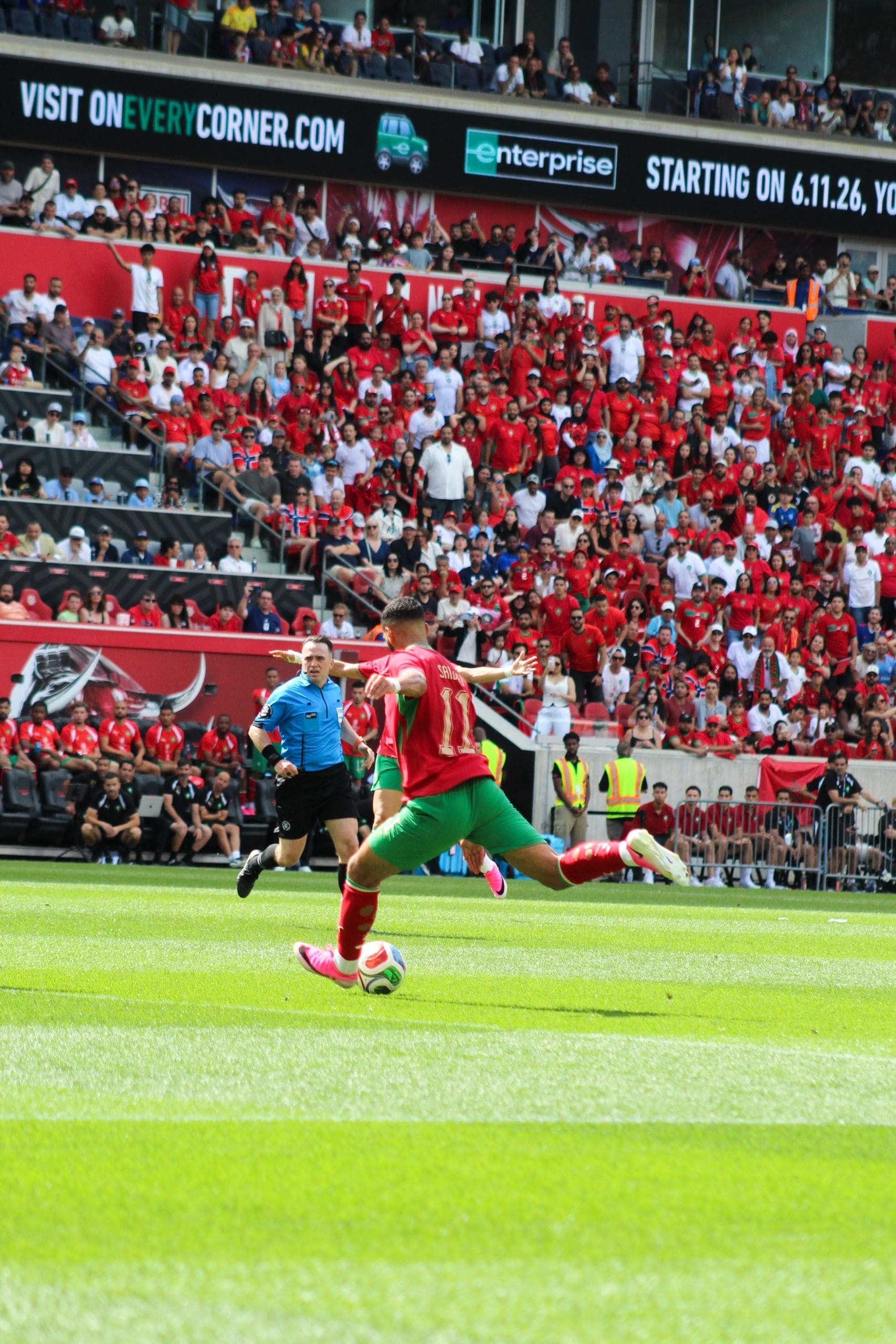
The atmosphere at Sports Illustrated Stadium was electric from the 3 p.m. kickoff. The stands shook with chants and songs that made the venue feel like it had been transported to Casablanca. For the better part of 90 minutes, this was an exclusively Moroccan crowd in sound and spirit—and it showcased to fans across the country what the sport looks and feels like at the top level.
In attendance were players and coaches from MLS, MLS Next Pro, NWSL, USL, and USL W. Every one of them had nothing but praise for what they witnessed. The pace, the precision, the physical intensity — it gave everyone in the building a clear-eyed sense of how quickly the game is played when the best teams in the world are at full speed.
Four days out from the tournament opener, this was the kind of Sunday afternoon preview that generates real buzz. The crowd that showed up in Harrison will not be the last to pack a stadium for this World Cup.
A Fast Start, Then a Concerning Exit
Morocco set the tone inside the first 10 minutes. Ezzalzouli, bright and dangerous throughout the opening half, picked up the ball on the right flank and slid a pass into Brahim Díaz, who finished crisply with his right foot from the right side of the box—bottom left corner, no chance for Ørjan Nyland. It was exactly the kind of aggressive, incisive football Morocco will need when the knockout rounds arrive.
The lead held, but the mood shifted in the 29th minute when Mazraoui pulled up and signaled to the bench. He was replaced by Youssef Belammari, and initial examinations after the match were described as reassuring. The FRMF’s medical team expressed confidence he would be fit for the tournament opener. Whether that optimism holds will be closely watched.
Norway had their moments before the break. Erling Haaland rattled a header that was blocked in the 34th minute, and Antonio Nusa forced a sharp save from Yassine Bounou just before the halftime whistle. The Atlas Lions went into the locker room ahead but down Ezzalzouli, their most threatening player of the half.
Ødegaard Levels It Late
Both coaching staffs used the second half as an opportunity to manage workloads. Mass substitutions around the 64th-to-72nd-minute mark rotated through the reserves on both sides—standard procedure for a tune-up of this kind.
Morocco dominated possession through the 70th minute without finding a second goal. Norway’s response came almost immediately after their own wave of changes. Oscar Bobb, on the pitch just three minutes after coming on as a substitute, slipped a pass to Martin Ødegaard at the center of the box. The Arsenal captain drilled it left-footed into the bottom right corner in the 75th minute. Norway level.
Morocco pushed for a winner. Bilal El Khannouss picked up a yellow card in the 82nd minute as the fouling and frustration ticked up. Amaimouni-Echghouyab had the best late chance but fired wide in the 89th minute. The final whistle came just after 4:30 p.m., bringing a 1–1 draw that will feel like a missed opportunity for Morocco—and a significant injury concern heading into one of the biggest tournaments in the history of the sport.
Ezzalzouli: 3-to-4 Weeks
The Ezzalzouli situation is the more serious of the two. The FRMF confirmed a right knee MCL sprain, with a recovery timeline of three to four weeks. He will remain with the squad, but barring an unexpectedly fast recovery, he will not feature in Morocco’s group stage matches.
The winger was integral to Morocco’s attacking rhythm on Sunday—creating the opening goal, drawing defenders, and forcing Nyland into uncomfortable moments before the injury ended his afternoon. Losing him this early changes Morocco’s wing dynamics considerably.
Mazraoui, by contrast, appears more likely to recover in time. His shoulder injury prompted an early substitution, but the medical staff’s tone after the match suggested they were not alarmed. His status will be monitored over the coming days.
Post-Match Reaction
Norway’s players and staff left the field with a clear respect for Morocco’s quality and the intensity of the match. Goalkeeper Ørjan Nyland described the physicality as “something we are used to in international football,” a reminder that tune-ups often carry more bite than expected. He also praised Morocco’s talent across the pitch, calling them “a very good team” with global‑level players.
Martin Ødegaard, who scored the equalizer, spoke about his first trip to the United States and the warm reception he received—a small but telling detail about the growing footprint of the sport here. He also noted the increasing number of Norwegian players moving to MLS, saying the league “is growing and will grow even more.”
Norway manager Ståle Solbakken addressed off-field matters with characteristic bluntness, including a communication issue with a Scottish club over injury information. His comments underscored the logistical challenges national teams face during pre‑tournament camps abroad.
A Bridge to What Comes Next
Despite the off-field questions and the physical toll of the afternoon, both sides left Harrison with a clear sense of where they stand heading into the World Cup. The match offered answers, raised new concerns, and delivered the kind of intensity that tune-ups rarely provide—all of it shaped by a crowd and atmosphere that felt far bigger than a friendly.
What Comes Next
Morocco opens their 2026 World Cup campaign on Saturday, June 13, against the mighty Brazilians at MetLife Stadium, aka New York/New Jersey Stadium, in East Rutherford, NJ, right down the road from Sports Illustrated Stadium. The Ezzalzouli injury forces head coach Walid Regragui to reconfigure his attacking options earlier than planned. The depth at his disposal will be tested.
Norway’s performance on Sunday was controlled and efficient. Ødegaard looked sharp. Haaland was active, even if the equalizer came from someone else. They leave Harrison with a clean bill of health, which may be the most meaningful result of the afternoon. They will open their World Cup campaign on Tuesday, June 16, 2026, at Gillette Stadium against Iraq at 1:00 PM.
For both teams, the preparation is over, and after a day when the stadium shook, the crowd roared, and injuries reshaped the narrative, the World Cup now arrives not as an idea but as an unavoidable reality waiting just four days ahead.
The stadium shook, the crowd roared, and the World Cup is four days away. If you want every moment of it—unfiltered, uncompromised, and written by people who actually watch the game—our World Cup newsletter is yours for $2.
— Bad Dawg Sports: Runs the pack.
Discover more from Bad Dawg Media Group
Subscribe to get the latest posts sent to your email.


