

By J.J. Pavlick | New York, NY | June 14, 2026
VANCOUVER — Türkiye spent the week telling the world that Australia did not belong on the same field. Their captain, Hakan Çalhanoğlu, said his side had “more qualities and a more talented team.” Midfielder İsmail Yüksek laughed off Australia’s experience advantage and dismissed the idea that the Socceroos could trouble them. The tone was confident, loud, and unwavering.
Australia heard every word Türkiye spent the week broadcasting, but they refused to dignify any of it with a public response. They waited for the only moment that matters in this sport—the one when the scoreboard tells the truth—and when it arrived, they delivered it without hesitation.
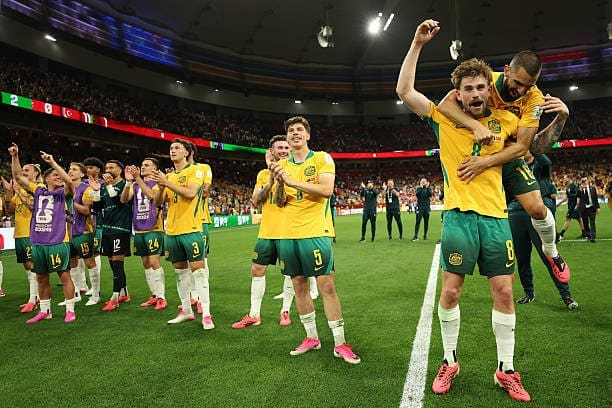
Their 2–0 victory at BC Place was not a surprise to the players who produced it. It was the product of a plan, a belief in their structure and a refusal to let Türkiye’s noise shape their identity.
A Week of Turkish Certainty Meets an Australian Team That Never Accepted the Premise
Türkiye arrived in Vancouver convinced the match would be a formality. Çalhanoğlu’s comments set the tone, and Yüksek’s laughter reinforced it. They spoke as if the match were already decided.
Tony Popovic never matched the volume. He did not attempt to win the press conference. Instead, he offered a single line that carried more weight than anything Türkiye said.
“Our goal is to spoil the party,” he told reporters.
Inside the Australian camp, the message was clear. They did not need to trade insults. They needed to prepare.
Aiden O’Neill, the NYCFC midfielder who has become the emotional anchor of this squad, said the group’s belief had grown steadily throughout the week. “We know what we are,” he said. “We know what we can handle.” His tone was calm and measured, but it carried conviction. Hours after the Knicks pulled off their own upset in San Antonio, O’Neill delivered a performance that matched the spirit of his adopted city: organized, unbothered, and unwilling to be intimidated by reputation.
Türkiye Controlled the Ball, Australia Controlled the Match
When the match began, Türkiye played exactly the way a favorite expects to play. They held 72 percent possession, completed 635 passes, and fired from every angle. On paper, it looked like dominance. On the field, it looked like a team mistaking activity for control.
Australia allowed Türkiye to have the ball because possession without purpose is harmless. The Socceroos defended in a compact block, won 41 duels, and forced Türkiye into a long sequence of blocked or rushed attempts. Patrick Beach made eight saves, but none required the spectacular. Australia’s structure did the work.
Popovic later said the match unfolded “exactly how we drew it up,” adding, “We knew they’d have the ball. We knew they’d take shots from distance, we were comfortable with that.”
One Chance, One Goal, and a Shift in the Stadium
The breakthrough came midway through the first half, and it arrived with the kind of calm that only a team untouched by pressure can summon. Australia had spent nearly half an hour absorbing Türkiye’s possession without ever losing their shape, and when the opening finally appeared, they treated it with the seriousness of a team that had been waiting for it all week.
Paul Okon‑Engstler slipped a measured ball between two defenders, and Nestory Irankunda—just 18, but carrying himself like someone who had been playing World Cup matches for a decade—stepped into the space with complete certainty. He didn’t rush or hesitate. Instead, he picked his spot and drove the ball into the bottom corner with a finish that belonged to a player far older than he is.
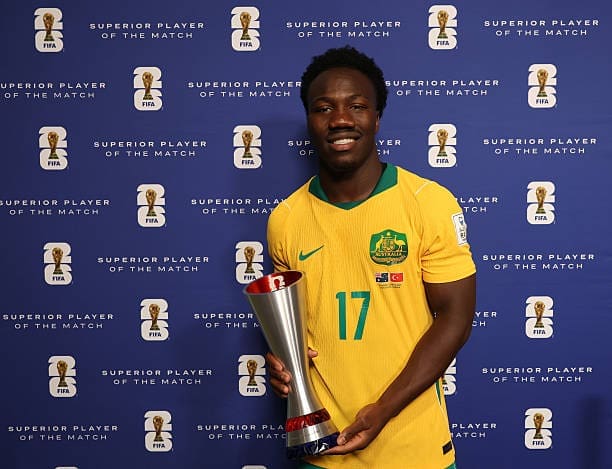
The reaction inside BC Place was immediate and overwhelming. The Australian end erupted in a single, rising wave of noise, while Türkiye froze for a moment that said more than any pre‑match quote ever could. The stadium felt the shift before the players did. Australia had not stolen a goal; they had claimed the match’s first moment of truth.
Metcalfe Ends the Debate
Türkiye continued to dominate possession, but their attacks grew increasingly predictable. They created two big chances and missed both. Australia created one and scored it.
In the 75th minute, Connor Metcalfe collected a loose ball outside the box and curled a low shot into the bottom corner. It was a goal that reflected the entire performance: calm, precise, and delivered by a team that understood exactly what the moment required.
Popovic praised both scorers afterward. “We didn’t get many clear chances,” he said, “but the ones we had, we finished. That’s the difference at this level.”
Türkiye Confronts the Consequences of Their Own Words
Vincenzo Montella walked into the press room carrying the weight of a week that had unraveled in front of him. The confidence his team projected before the match had evaporated, replaced by a blunt admission of what went wrong. “We lacked quality in the box,” he said, his voice measured but unmistakably frustrated. “We had possession, but we didn’t use it well.”
He did not try to disguise the truth. Türkiye’s approach—a steady stream of long‑range attempts and hopeful crosses—had played directly into Australia’s structure. “It suited them,” Montella acknowledged. “We made it too easy for them to defend.”
The questions came quickly about his most scrutinized decision: starting Juventus prodigy Kenan Yıldız on the bench. Montella defended the choice by citing fitness precautions, insisting he had to consider the player’s long‑term availability in the tournament. The explanation did little to ease the skepticism in the room. Yıldız had been one of Türkiye’s few bright sparks after coming on, and the decision to hold him out from the start now hung over the result.
Hakan Çalhanoğlu, who had spoken with such certainty the day before, offered a very different tone after the loss. He credited Australia’s organization and admitted that Türkiye had been outplayed in the areas that mattered. “Australia defended very well,” he said. “Talent alone doesn’t win World Cup matches.”
It was a stark reversal from the confidence he projected earlier in the week — and a reminder that the words spoken before a match can linger long after the final whistle.
A Group Reframed by a Team That Refused to Play the Part Assigned to Them
The landscape of Group E looks very different now. The United States still sits narrowly ahead on goal difference after failing to put Paraguay away, but the dynamic of the group has shifted. Australia’s meeting with the U.S. on Friday is no longer a fixture tucked quietly into the schedule; it has become a match with genuine consequence, one that will help determine who controls the path out of the group. Türkiye, meanwhile, heads toward their meeting with Paraguay carrying pressure of their own making—pressure born not from misfortune, but from a week of certainty that dissolved the moment the match began.
What Australia Did To The Group
Australia’s win did more than add three points to the table. It altered the way this group will be played and the way these teams will be perceived. Opponents who spent the past week treating the Socceroos as an afterthought will now have to prepare for a side that showed discipline, clarity, and a refusal to be intimidated by reputation. The performance in Vancouver forced a recalibration of expectations, not because Australia surprised themseleves, but because they revealed a level of control that Türkiye never anticipated.
They approached the match with a clear identity, trusted the structure that had carried them through the week, and executed with a maturity that belied the noise surrounding them. In doing so, they delivered the only verdict that matters at a World Cup—one written in goals, not predictions, and earned on the pitch rather than in the press room.
Final: Australia 2 – 0 Türkiye
Australia didn’t answer Türkiye’s week of talk with quotes or bravado—they answered it with a 2–0 scoreboard that left no room for interpretation. If you want coverage that treats the game the same way the Socceroos did tonight—direct, unbothered, and rooted in what actually happens on the pitch—our newsletter is $2 a year.
That’s it. No noise, no posturing, just the football that matters.
Discover more from Bad Dawg Sports - Global Sports Coverage & Analysis
Subscribe to get the latest posts sent to your email.