

By: J.J. Pavlick | Washington, D.C. | March 2, 2026
The United States has initiated one of the largest and most sophisticated military air campaigns in its history, targeting Iran’s long-range missile and drone capabilities in what officials describe as a decisive response to decades of Iranian hostility. The operation, dubbed “Epic Fury,” was authorized by President Donald J. Trump and is being executed in close coordination with allied Israeli forces.
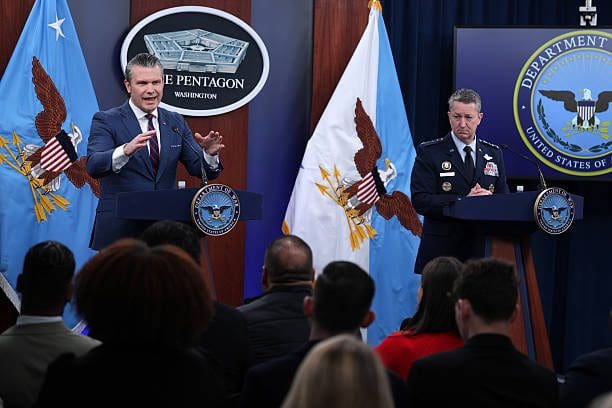
In a press briefing on Monday, Secretary of War Pete Hegseth and Chairman of the Joint Chiefs of Staff General Dan Caine provided an extensive overview of the campaign’s objectives, scope, and early results.
A Response to Decades of Tension
“For 47 long years, the expansionist and Islamist regime in Tehran has waged a savage, one-sided war against America,” Secretary Hegseth stated, referencing a history of Iranian-backed attacks on American personnel and interests across the Middle East. Hegseth characterized Iran’s actions in these strongly charged terms, making clear that this view reflects the administration’s position. He emphasized that the United States did not seek this confrontation, but is now determined to end it.
Secretary Pete Hegseth
Describing the campaign’s rationale, Hegseth said, “Their war on Americans has become our retribution against their ayatollah and his death cult.” He affirmed that the primary objective is to eliminate Iran’s ability to threaten the U.S. and its allies, particularly through its ballistic missile arsenal, drones, and naval assets.
Massive Coordinated Operation
General Caine detailed the scale and complexity of the operation, which began on February 28 at 9:45 a.m. Tehran time. More than 100 U.S. aircraft launched from both land and sea, targeting over 1,000 pre-planned sites in the first 24 hours. For perspective, Operation Desert Storm targeted approximately 700 key sites over its first several days, while Operation Inherent Resolve averaged fewer than 50 airstrikes daily during its initial campaign. This puts Epic Fury among the most extensive opening air campaigns in recent U.S. military history. The operation involves all branches of the U.S. military, supported by extensive cyber and space warfare elements designed to degrade Iranian command, control, and communications.
“These movements ensured that U.S. forces remain postured, protected, and ready to respond decisively to any emerging threat,” Caine explained, highlighting the rapid deployment of personnel, advanced fighter jets, carrier strike groups, and logistics support to the region.
The campaign has also leveraged American B-2 bombers flying round-trip missions from the United States and coordinated with Israeli forces conducting parallel airstrikes. According to officials, the operation has already achieved localized air superiority and degraded Iranian military infrastructure.
American and Allied Losses
In a somber update Monday evening, officials confirmed the loss of six American service members. Two personnel previously listed as unaccounted for were recovered from a facility struck during the initial Iranian barrage. Additionally, the Department of War confirmed the loss of three Air Force F-15E fighter jets. General Caine clarified that these aircraft were not lost to enemy fire, but were downed in a friendly fire incident involving Kuwaiti air defense batteries. All aircrew reportedly ejected safely. Both Hegseth and Caine expressed deep condolences for the fallen and their families, reiterating the nation’s commitment to honor their sacrifice.
Objectives, Exit Strategy, and Duration
When asked about the operation’s goals and timeline, Hegseth outlined clear military objectives: destroying Iran’s offensive missiles, missile production facilities, naval capacity, and preventing the regime from ever acquiring nuclear weapons. He explained that, beyond these military goals, the United States is also seeking measurable political and diplomatic results such as Iran halting support for regional militant proxies, a verified end to hostilities against American interests, and meaningful engagement with international bodies on security issues. He declined to specify a timeframe for completion, stating, “The mission for our warfighters, which is what matters to us, is very, very clear, and they’re executing it right now violently.”
General Caine added that a comprehensive battle damage assessment is ongoing and that operational plans are being adjusted as new intelligence becomes available.
Regional and Domestic Security
The U.S. operation has been carried out in close collaboration with regional allies, including Israel, Qatar, the United Arab Emirates, Kuwait, Jordan, and Saudi Arabia, all of whom have contributed to the air defense effort. American and allied systems have reportedly intercepted hundreds of Iranian missiles and drones aimed at U.S. forces and regional targets.
Addressing concerns about possible Iranian retaliation within the U.S., Hegseth said that the administration is vigilant and prepared, with interagency coordination actively monitoring for any threats, including the potential for sleeper cells.
No Ground Troops—But Options Remain Open
Secretary Hegseth confirmed that there are currently no American ground troops operating inside Iran. However, he refused to rule out any future actions, citing the need for operational security and strategic flexibility.
A Message to the Iranian People and U.S. Forces
Hegseth delivered a direct message to the people of Iran, framing the campaign as an opportunity for them to seek change after years of repression. He acknowledged the strength and diversity of Iran’s civil society, recognizing the wide spectrum of voices, including students, workers, intellectuals, and ethnic minorities, who have sought a better future in the face of adversity. By emphasizing respect for the aspirations and resilience of all Iranians, Hegseth called for unity against the repression imposed by the regime, while urging hope for genuine progress.
He also addressed American service members, invoking the “warrior ethos” and underscoring the historic nature of the operation: “History is watching. Be the force you swore an oath to be—focused, disciplined, lethal, and unbreakable.”
Looking Ahead
Operation Epic Fury, now entering its third day, represents a significant escalation in the U.S. response to Iranian provocations. Both Hegseth and Caine emphasized that while the campaign is ongoing, the objectives are unambiguous and the resolve is unwavering: the United States will not tolerate threats to its people or its interests, and will act decisively to eliminate them. At the same time, officials acknowledged that the future remains uncertain. Potential diplomatic off-ramps are being evaluated in coordination with international partners, even as military operations continue. The administration recognizes that unintended consequences could arise as the situation develops, but stressed its commitment to adapt to emerging challenges while keeping American interests at the forefront.
For continued updates, visit war.gov and subscribe to Department of War press releases.
Discover more from Bad Dawg Sports - Global Sports Coverage & Analysis
Subscribe to get the latest posts sent to your email.