
By: J.J. Pavlick| New York, NY | February 1, 2026
There is a backyard somewhere in Yukon, Oklahoma, where the outlines of a baseball career were first drawn. The house belonged to the Benge family—three boys, all players, none of them willing to let a younger brother take it easy. Carson was always the smallest one out there, swinging equipment that was a size too big, facing off against kids three, four, five years older than him.
That is where this story starts for Carson Benge, it does not start at Oklahoma State, or at the 2024 MLB Draft, or at MCU Park in Brooklyn. It starts in a Yukon backyard with two older brothers who refused to let Carson coast.
Raised on It
Garrett Benge went to Cowley Community College before transferring to Oklahoma State. The Cleveland Indians drafted him in the 22nd round in 2015. He chose college, went back to Stillwater, and the Boston Red Sox drafted him again in the 13th round in 2017. He spent three years working through Boston’s system. Tyler Benge played ball at Southwestern Oklahoma State in Weatherford. Neither brother made it to the big leagues, but both understood the game at a level that shaped the youngest Benge in ways that no youth league could replicate.
Carson was not just learning how to hit. He was learning how to compete, was borrowing their bats, their gloves, their ideas about what the game required. He was reading pitchers at 11 years old because the guy throwing to him was 15. That kind of compression accelerates development — not always cleanly, not always without bad habits, but it accelerates.
By the time Carson Benge walked into Yukon High School, he was already a different kind of baseball player.
High School, a Growth Spurt, and a Pandemic
A growth spurt entering freshman year left him tall and lanky — the coordination had to catch up. His childhood swing was wild, unrefined, all energy and athleticism without structure. Over four years of high school, that energy got shaped into something more purposeful: a powerful left-handed stroke that could drive the ball to all fields.
Then COVID-19 hit
His entire junior season was cancelled. Parts of his senior year were disrupted before they could fully unfold. For a high school prospect building toward a draft, those are critical development months — the live at-bats, the competitive reps, the film that scouts use to evaluate. Benge lost most of it.
What he kept was his numbers when play resumed. As a senior, he hit .490. On the mound, he went 8-1 with 124 strikeouts. He was named OCABCA North Player of the Year and COAC Offensive Player of the Year. The production was hard to ignore even if the sample was thinner than anyone would have liked.
He went undrafted in the 2021 MLB Draft. He preferred it that way. Oklahoma State had already offered, and he was going.
Oklahoma State: When the Two-Way Dream Became Real
The Cowboys got an unusual piece when Benge arrived in Stillwater — not because he was the most projectable bat in the class, but because he could actually pitch too.
He never got to prove it in 2022. Tommy John surgery on his elbow wiped out his freshman year before it started. Twelve months of recovery, rehab, and waiting.
When he came back in 2023, he made up for lost time immediately
In 59 games as a redshirt freshman, Benge hit .345/.468/.538. He knocked 17 doubles, hit 7 home runs, stole 8 bases in 10 attempts, and drew 42 walks against only 32 strikeouts. Carson led the team in batting average and on-base percentage. Suprisingly, he also took the ball as a pitcher, throwing 35 innings with 35 strikeouts. Was named to the Big 12 All-Freshman Team, earned All-Big 12 First Team honors as a utility player and Second Team honors as an outfielder, and became a finalist for the John Olerud Two-Way Player of the Year Award — losing out to Caden Grice of Clemson.
The summer of 2023 sent him to the Cape Cod Collegiate Baseball League, where he played nine games for the Chatham Anglers. He hit .345/.424/.414 and threw a scoreless inning.
2024 He Turned It Up
His 2024 college season was even better. In 61 games, Benge hit .335/.444/.665 — the slugging number a significant step forward from his already strong freshman line. He put up 24 doubles, 2 triples, and 18 home runs. He stole 10 bags in 14 attempts. The walks stayed high, the strikeouts ticked up, but the power production was legitimately elite. On the mound, he was efficient: 3.16 ERA across 37 innings in 18 appearances, 26 hits allowed, 11 walks, 44 strikeouts.
He was a finalist for the Olerud Award again — this time losing to Jac Caglianone of Florida.
The swing mechanics that evaluators flagged heading into the draft — an extremely open stance, hands held high, bat wrapped behind the head in a complex loading movement — were already being refined during that 2024 season. The extra hand movement became less pronounced. He was getting to his hitting position quicker and cutting out the unnecessary length in his load.
The bat was going to play. The only question was how quickly it would translate to wood.
The Draft, the Mets, and the First Test
The 2024 MLB Draft put Benge at 19th overall. The New York Mets took him in the first round. Most evaluators had projected him as a back-half first-rounder — the Mets took him right where expected and signed him quickly for $3,997,500, slightly below the slot value of $4,219,200. No drama, no leverage games. He was a Met.
He went straight to Low-A St. Lucie for a 15-game debut — hitting only, no mound work. In 15 games, he hit .273/.420/.436 with 2 doubles, 2 home runs, 3 stolen bases, 11 walks, and 14 strikeouts. The plate discipline showed up immediately. He ranked third in the Mets’ top prospect list heading into 2025.
The real test was coming, it was just a matter of time for the young player from Oklahoma.
Brooklyn: Where It Clicked
High-A is where a lot of college bats find out whether they actually belong. The pitching is sharper. Sequencing is more intentional. The breaking ball that a reliever threw at Oklahoma State on a 2-2 count is now the same pitch a starter uses to set up his fastball on 1-0. The game is playing a different game with you.
Benge handled it, and put the system on notice that he is for real.
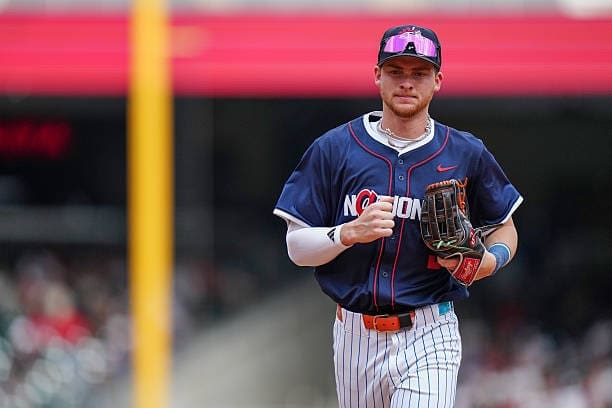
In 60 games at Brooklyn in 2025, Benge hit .302/.417/.480. He put up 18 doubles, 5 triples, and 4 home runs. While he walked 41 times against 50 strikeouts. He stole 15 bases in 17 attempts — an efficiency rate that reflects good reads and smart decision-making, not reckless aggression. His BABIP sat at .372, a number that raises legitimate questions about sustainability — but when you spray the ball to all fields and generate consistent hard contact, elevated BABIP is at least partially skill-driven.
The plate discipline was real. His full-season cumulative swing rate sat at 42.4%. With a swinging strike rate came in at 8.1%, just under the major league average. Benge’s contact rate was 80.9%, slightly above the MLB average. For a High-A bat adjusting to increasingly professional pitching, those are numbers that suggest a genuine feel for the strike zone — not a guess-and-swing approach.
Improving Since College
The mechanical refinements from his final college season continued into Brooklyn. His line drive rate improved to 24.7%, up from 18.1% and 15.0% in his two college seasons. While his ground ball rate dropped to 42.5%, the fly ball rate landed at 31.4%. The trend line points toward a hitter who is genuinely learning to lift the ball with more consistency — important for a prospect whose power projection depends on getting the ball in the air.
The spray chart told a clear story: he went 39.1% pull, 22% center, 38.9% the other way in 2025. That opposite-field production is real. He naturally goes oppo on middle-away pitches, and while that creates a high contact profile, it also means he leaves some damage on the table when he could be pulling pitches for extra bases. His pulled fastball rate sat at just 8.3%, and his median launch angle stayed below 10 degrees in 2024. At Syracuse in 2025 it averaged around 9 degrees — not enough to maximize the power the bat speed suggests he has. That is the ongoing work.
A Noticeable Weakness
Against left-handed pitching, a weakness that showed up in his college career, a real split emerged in 2025: .295/.379/.512 against right-handers, .232/.407/.326 against lefties. He can draw a walk against a left-hander—the OBP against them stayed above .400—but the damage is not there. Benge had struggles with pitches on the inner half from the left side; the best result is an inside-out swing to the opposite field, the worst result is getting jammed. He will need to close that gap.
In the outfield, his reads off the bat are good, his routes are efficient, and he has average-to-above-average speed. There was genuine debate at draft time about whether he could stick in center field long-term. In Brooklyn, he showed enough range to hold his own. The questions that remain about his future defensive home are less about current ability and more about projection — if his frame fills out over the next few years, the slide to right field becomes more likely. And in a corner, with a plus arm, he profiles well.
The Promotion Arc: Binghamton and the Bump at Syracuse
The Mets promoted Benge to Double-A Binghamton at the end of June 2025. The questions about whether his Brooklyn numbers would hold at a higher level were answered quickly and emphatically.
In 32 games for the Rumble Ponies, Benge hit .317/.407/.571. He put up 6 doubles, 1 triple, and 8 home runs in 126 at-bats. While drawing 18 walks against 23 strikeouts. The solid part was they couldn’t overwhelm him. Carson was, if anything, better than he had been at Brooklyn.
That kind of Double-A performance from a 21-year-old who finished the 2024 draft year at Low-A — finishing the year at High-A for his debut — is significant. The jump from High-A to Double-A is where a lot of prospects stall. Benge cleared it without a visible adjustment period.
The Mets sent him to Triple-A Syracuse in mid-August.
It was a rough introduction. In 24 games, Benge hit .178/.272/.311 with 16 hits in 90 at-bats, 3 home runs, and 19 strikeouts. His BABIP cratered to .188 — the kind of number that suggests some bad luck was involved, but also that the pitching was presenting new problems that he had not yet solved. He was placed on the injured list shortly after arriving. When he returned, the struggles continued.
His full-season combined line across all three levels — .281/.385/.472 with 25 doubles, 7 triples, 15 home runs, and 22 stolen bases in 26 attempts, with 68 walks against 92 strikeouts — reflects what happened before Syracuse more than what happened at Syracuse. A rough few weeks at Triple-A after an injury does not erase what he built from April through August. It adds a data point, but the story of 2025 was written in Brooklyn and Binghamton.
What It Adds Up To
Carson Benge is 23 years old. He has two-way bloodlines, a family that treated baseball as a serious pursuit from the time he could hold a bat, and a swing that has been getting better every year he has played competitive baseball. The young Benge has shown genuine plate discipline at every level — the kind that does not evaporate when pitchers start working smarter against him. Generating exit velocities over 110 MPH, while spraying the ball with purpose.
The questions are real. The platoon split against lefties is something pitchers at Triple-A and above will attack. The launch angle and pull-side damage need to improve for the power to fully translate. His defensive home may shift as his body matures.
But the kid who grew up borrowing his brothers’ equipment, who had his junior year cancelled by a pandemic, who missed his entire freshman college season to Tommy John surgery, and who still made it to the 19th pick in the first round of the MLB Draft — that kid hit .302 in High-A and looked completely comfortable doing it.
Brooklyn was a statement. The Mets prospect list is going to keep rearranging itself as Benge continues to develop, but based on what he showed at MCU Park in 2025, the question is not whether he belongs. The question is only how fast he gets there.
Real reporting. Real access. No fluff. If you found this valuable, there is more where it came from. Subscribe now and run with the pack.
Discover more from Bad Dawg Sports - Global Sports Coverage & Analysis
Subscribe to get the latest posts sent to your email.