


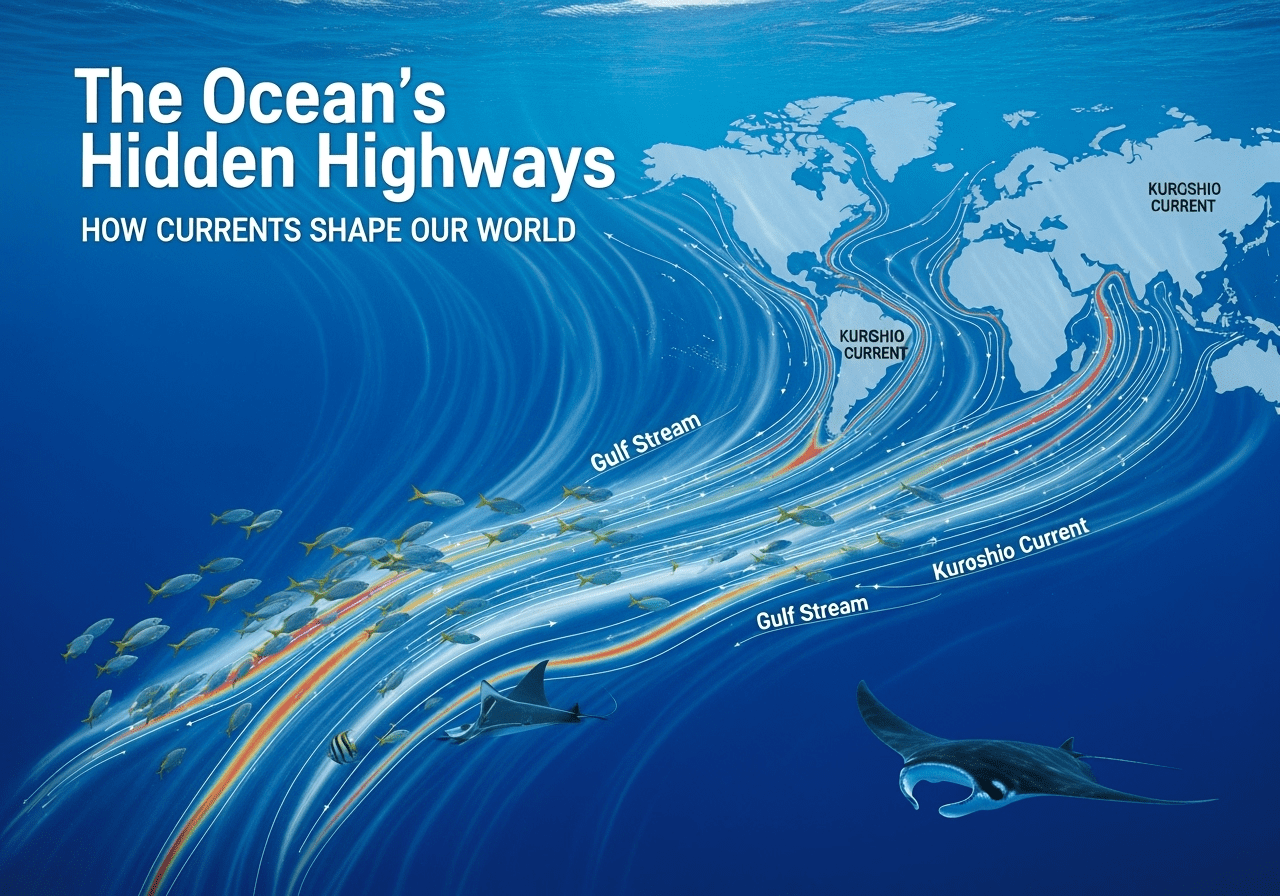
Your Source for Global Sports News – and today, we’re diving deep into the science that affects every sport played near our coasts and every athlete who travels across oceans.
Introduction: The Planet’s Circulatory System
Imagine invisible rivers flowing through our oceans – some as wide as entire countries, others as deep as Mount Everest is tall. These are ocean currents, and they’re arguably the most potent force shaping life on Earth that most people never see.
Ocean currents transport more water than all the world’s rivers combined – about 100 times more. The Gulf Stream alone carries 30 times the flow of all rivers on Earth, moving at speeds up to 5.6 mph and stretching 60 miles wide.
The Science Behind the Flow
What Drives Ocean Currents?
Ocean currents are powered by four primary forces:
1. Wind Patterns
- Trade winds near the equator push surface waters westward
- Westerlies in mid-latitudes drive currents eastward
- Creates the basic circular patterns we see in each ocean basin
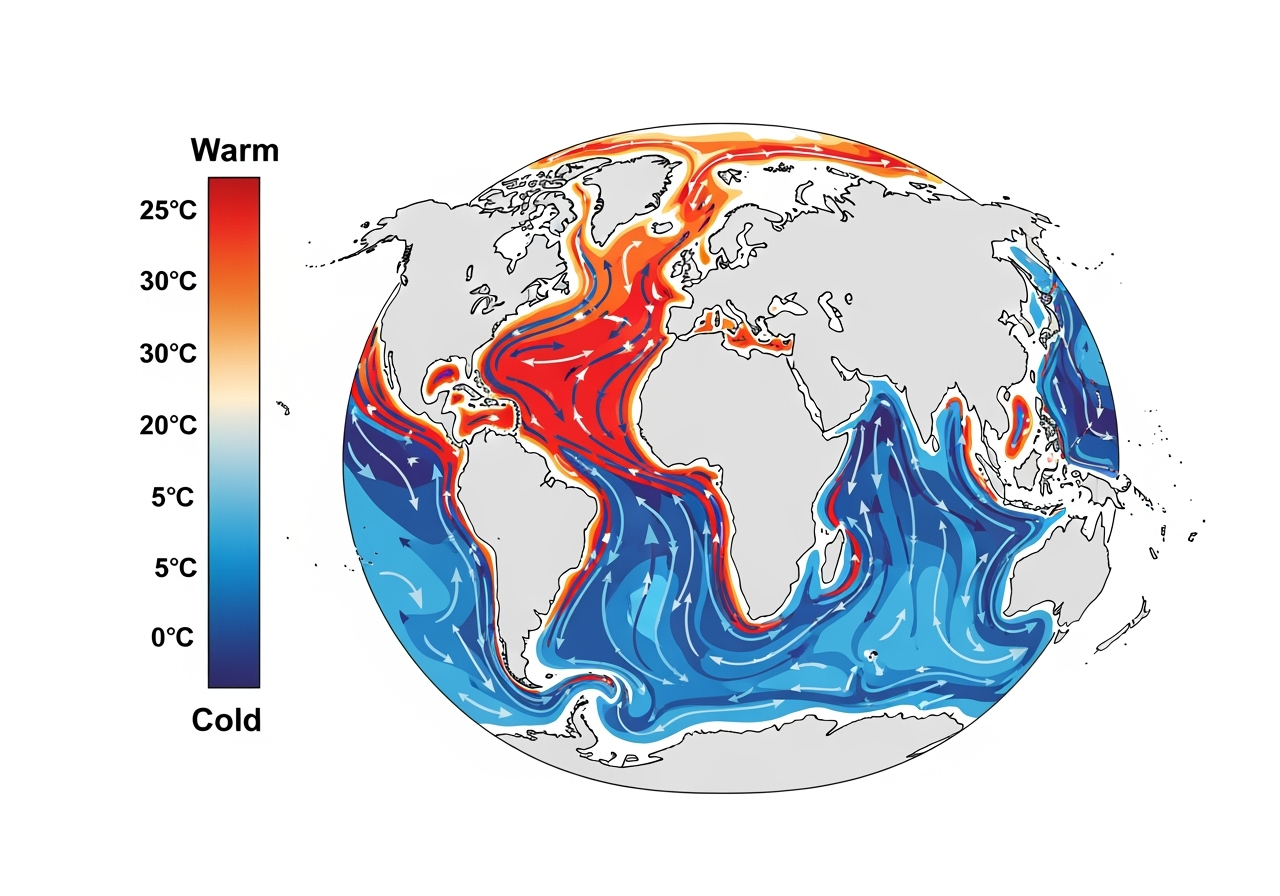
2. Temperature Differences
- Warm water expands and becomes less dense
- Cold water contracts and becomes more dense
- Creates vertical circulation as dense water sinks
3. Salinity Variations
- Saltier water is denser than fresh water
- Evaporation increases salinity; precipitation decreases it
- Drives deep-water formation in polar regions
4. The Coriolis Effect
- Earth’s rotation deflects moving water
- Clockwise circulation in Northern Hemisphere
- Counterclockwise circulation in Southern Hemisphere
The Global Conveyor Belt: Earth’s Climate Engine
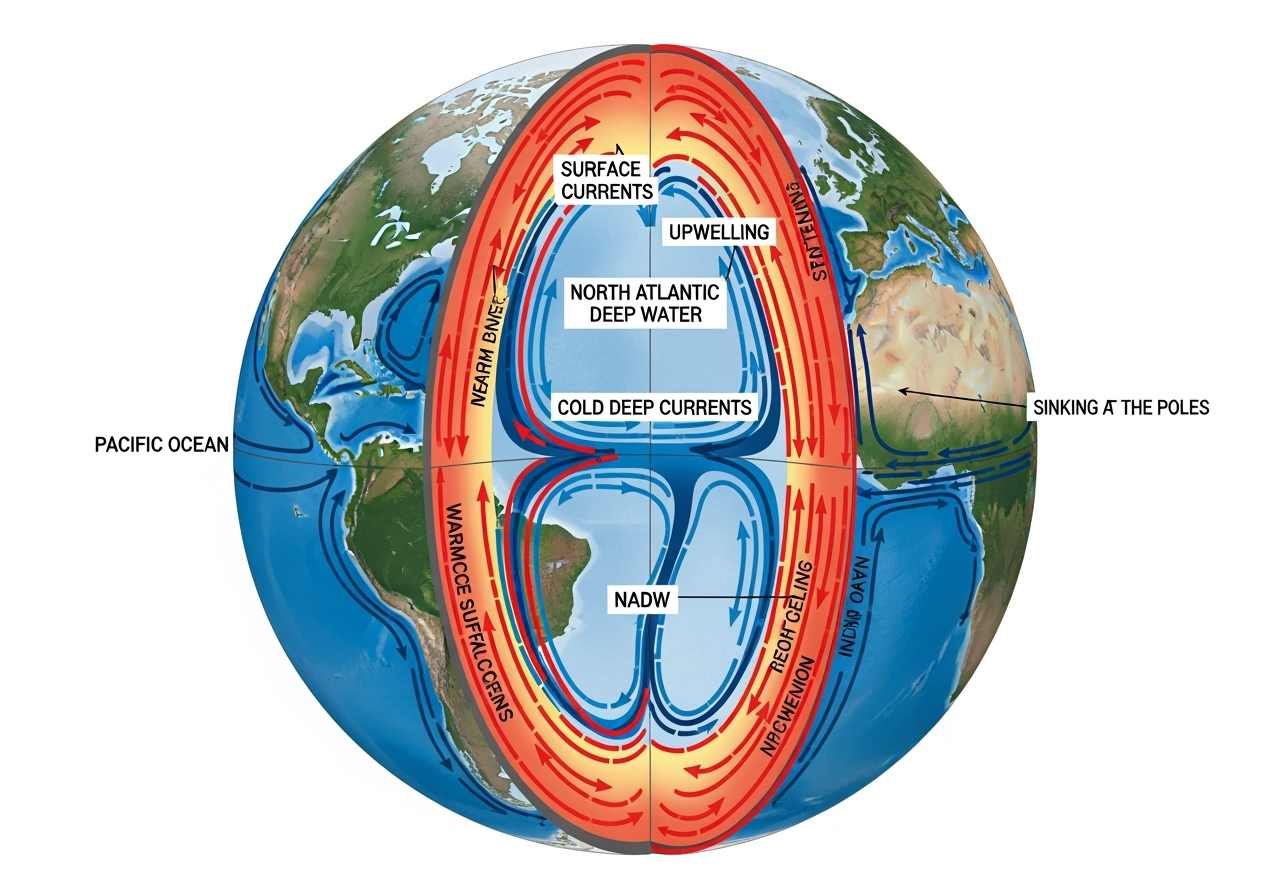
The most crucial current system is the thermohaline circulation, often referred to as the “global conveyor belt.” This massive system connects all ocean basins and takes about 1,000 years to complete one full cycle.
How It Works:
- Surface waters flow northward, carrying tropical heat toward poles
- Deep waters form when cold, salty water sinks in polar regions
- Bottom currents flow southward, eventually rising in other ocean basins
- Upwelling brings nutrient-rich deep water to the surface
Key Statistics:
- Flow Rate: 15-20 million cubic meters per second
- Temperature Transport: Equivalent to 100 times global energy consumption
- Cycle Time: 500-2,000 years for complete circulation
- Depth Range: Surface to 4,000+ meters deep
Regional Powerhouses: Ocean-by-Ocean Breakdown
Each ocean basin has its own unique current systems, shaped by geography, climate, and seasonal patterns.
Atlantic Ocean: The Gulf Stream System
- Gulf Stream: 30 Sverdrups flow rate (1 Sv = 1 million cubic meters/second)
- North Atlantic Drift: Extends Gulf Stream influence to Europe
- Canary Current: Cool, nutrient-rich southward flow off Africa
- Brazil Current: Warm southward flow along South America
Pacific Ocean: The Kuroshio and Beyond
- Kuroshio Current: “Black Stream” – Pacific’s Gulf Stream equivalent
- California Current: Cool, productive eastern boundary current
- Equatorial Counter Current: Eastward flow between trade wind belts
- Antarctic Circumpolar Current: World’s strongest current at 600 Sv
Indian Ocean: Monsoon-Driven Dynamics
- Agulhas Current: Fastest western boundary current (5+ mph)
- Somali Current: Reverses direction with monsoon seasons
- West Australian Current: Cool eastern boundary current
- Equatorial currents: Complex seasonal reversals
Seasonal Variations: Nature’s Rhythm
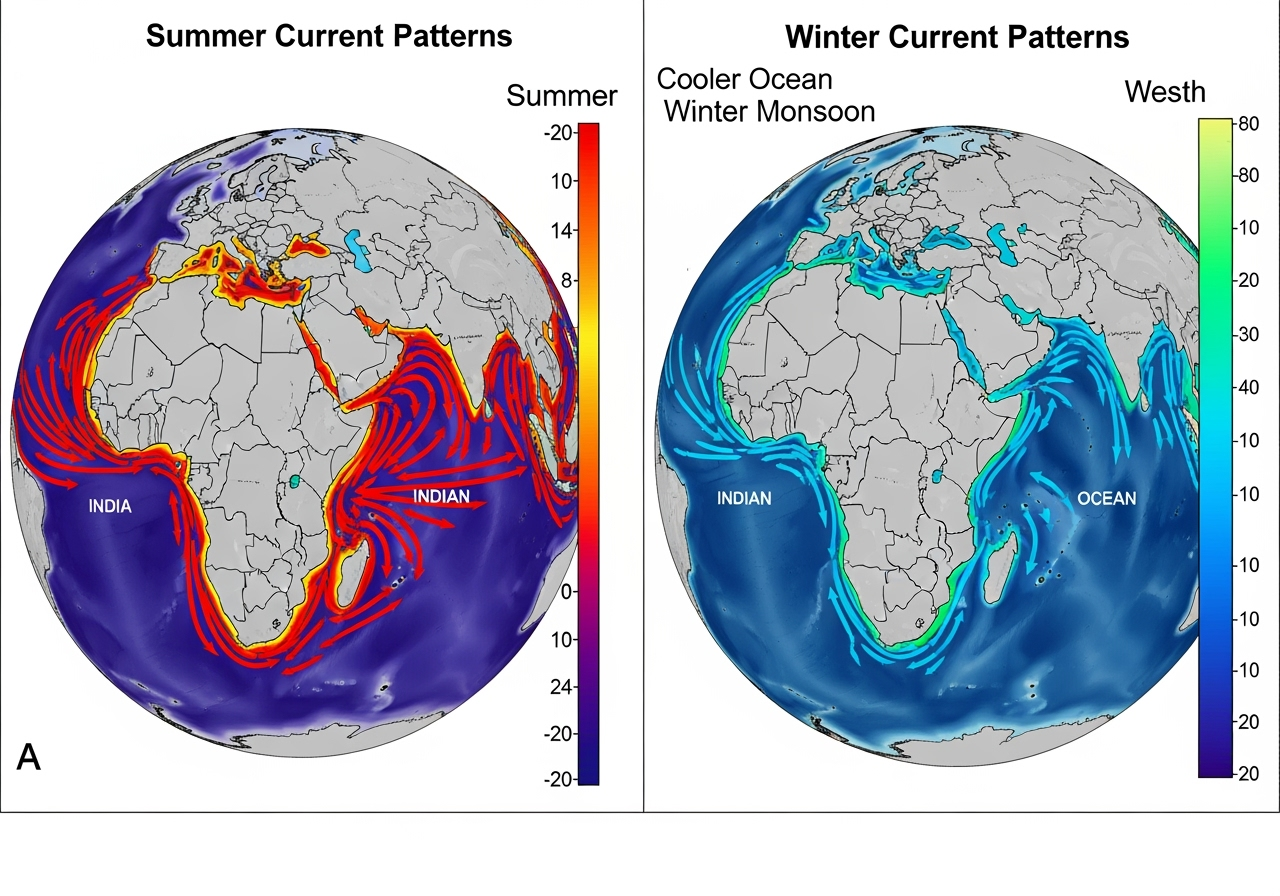
Ocean currents aren’t static – they pulse with the seasons like a planetary heartbeat.
Summer vs. Winter Changes:
- Gulf Stream: Shifts 100+ miles north/south seasonally
- Monsoon Currents: Complete reversals in Indian Ocean
- Upwelling: Intensifies during local summer months
- Arctic Currents: Dramatic changes with ice formation/melting
Impact on Marine Life:
- Migration Timing: Species follow seasonal current shifts
- Breeding Cycles: Timed to optimal current conditions
- Food Availability: Upwelling seasons create feeding bonanzas
- Temperature Zones: Shift hundreds of miles seasonally
Economic Impact: The Trillion-Dollar Current
Ocean currents are worth trillions to the global economy, affecting everything from shipping costs to fish catches.
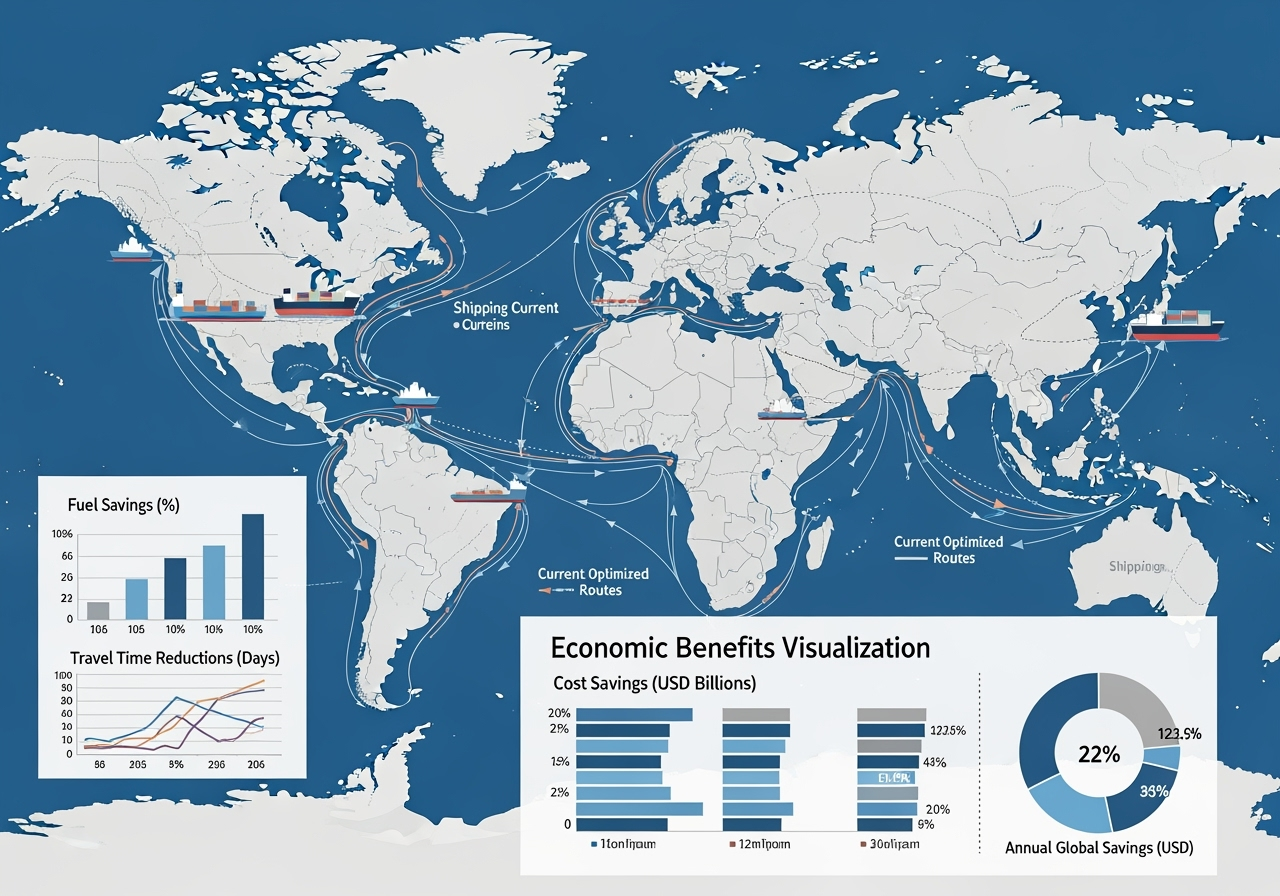
Shipping Industry Benefits:
- Fuel Savings: 10-15% reduction using favorable currents
- Time Savings: 2-3 days shorter trans-Atlantic crossings
- Route Planning: $50+ billion annual savings industry-wide
- Container Shipping: 95% of global trade depends on ocean transport
Fishing Industry Impact:
- Upwelling Zones: Support 50% of global fish catch
- Current Boundaries: Create most productive fishing grounds
- Seasonal Patterns: Determine fishing seasons and quotas
- Economic Value: $150+ billion annual global fisheries
Energy Production:
- Offshore Wind: Current data crucial for turbine placement
- Ocean Thermal: Temperature differences drive OTEC systems
- Tidal Energy: Enhanced by current interactions
- Potential Value: $500+ billion renewable energy market
Climate Control: Currents as Weather Makers
Ocean currents are the primary mechanism for global heat transport, moving warm water toward poles and cold water toward the equator.
Regional Climate Effects:
- Western Europe: 5-10°C warmer due to Gulf Stream
- Eastern Coasts: Generally warmer than western coasts at same latitude
- Desert Formation: Cold currents create coastal deserts
- Monsoon Systems: Driven by seasonal current changes
Extreme Weather Connections:
- Hurricane Intensity: Warm currents fuel stronger storms
- El Niño/La Niña: Pacific current shifts affect global weather
- Arctic Changes: Weakening currents alter polar climate
- Precipitation Patterns: Current temperatures affect rainfall
Marine Ecosystems: Life in the Flow
Ocean currents create and sustain marine ecosystems by transporting nutrients, heat, and marine life across vast distances.
Nutrient Transport:
- Upwelling Zones: Bring deep nutrients to surface
- Productivity Hotspots: Support 25% of global fish catch
- Food Web Foundation: Fuel phytoplankton blooms
- Oxygen Distribution: Prevent ocean dead zones
Species Migration:
- Sea Turtles: Navigate using current systems
- Whales: Follow currents for feeding and breeding
- Fish Populations: Larvae dispersed by currents
- Coral Reefs: Depend on current-delivered nutrients
Climate Change Impacts: A System Under Stress
Rising global temperatures are altering ocean currents in ways that could reshape our planet’s climate system.
Observed Changes:
- Gulf Stream Weakening: 15% slower since 1950’s
- Arctic Currents: Disrupted by ice loss and freshwater input
- Upwelling Changes: Shifting patterns affect marine productivity
- Deep Water Formation: Reduced in key polar regions
Future Projections:
- Thermohaline Circulation: Could weaken 20-50% by 2100
- Regional Cooling: Parts of Europe could cool despite global warming
- Sea Level Rise: Uneven due to changing current patterns
- Marine Ecosystems: Major shifts in species distribution
Tipping Points:
- AMOC Collapse: Atlantic circulation could shut down
- Arctic Changes: Ice-free summers alter global patterns
- Feedback Loops: Changes accelerate further warming
- Irreversible Shifts: Some changes may be permanent
Technology and Monitoring: Tracking the Invisible
Modern technology allows us to monitor and predict ocean currents with unprecedented accuracy.
Monitoring Systems:
- Satellite Altimetry: Measures sea surface height changes
- Argo Floats: 4,000+ robotic sensors measure temperature/salinity
- Moored Arrays: Fixed sensors track current speed/direction
- Ship-based Surveys: Detailed measurements along shipping routes
Prediction Models:
- Global Circulation Models: Forecast current changes
- High-Resolution Simulations: Predict local current patterns
- Real-time Data: Support navigation and fishing operations
- Climate Projections: Model future current scenarios
The Future of Ocean Currents
Understanding ocean currents is crucial for addressing climate change, managing marine resources, and adapting to a changing planet.
Research Priorities:
- Deep Ocean Monitoring: Expand sensor networks
- Current-Climate Interactions: Better understand feedback loops
- Ecosystem Impacts: Track changes in marine life
- Prediction Improvement: Enhance forecasting capabilities
Adaptation Strategies:
- Shipping Route Optimization: Adjust to changing patterns
- Fisheries Management: Adapt to shifting ecosystems
- Coastal Planning: Prepare for sea level changes
- Energy Systems: Design for changing ocean conditions
Conclusion: Respecting the Flow
Ocean currents are among Earth’s most powerful and important systems. They regulate our climate, support marine ecosystems, enable global commerce, and connect every corner of our blue planet.
As we face climate change, understanding and protecting these liquid highways becomes more critical than ever. The currents that have shaped human civilization for millennia are changing, and our response will determine the kind of planet we leave for future generations.
Whether you’re a sailor navigating by current charts, a surfer riding waves shaped by distant flows, or simply someone who enjoys the moderate climate that currents provide, these invisible rivers touch every aspect of life on Earth.
The ocean’s currents remind us that our planet is one interconnected system – what happens in the Arctic affects the tropics, and changes in the Pacific influence weather in Europe. In our globalized world, perhaps there’s no better metaphor for how we’re all connected than these vast, powerful streams flowing beneath the waves.
Discover more from Bad Dawg Media Group
Subscribe to get the latest posts sent to your email.