

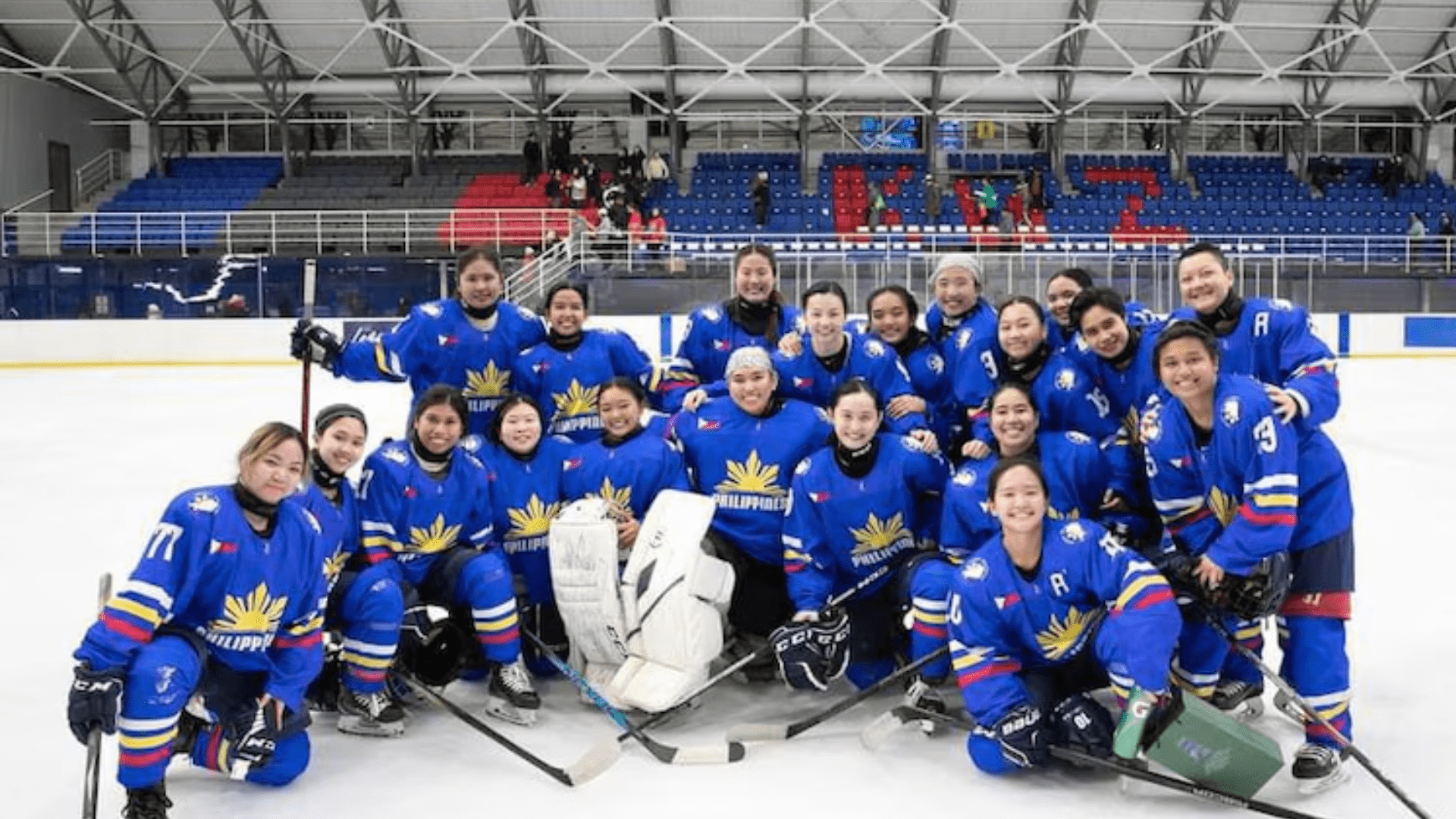
The Philippines captured their first Women’s Asia Cup title in dominant fashion, completing a perfect tournament run with a thrilling 4-2 victory over Iran on Friday at the Al Hili Ice Rink in Al Ain, United Arab Emirates.
Philippines’ Championship Performance
The Filipinas showcased their championship mettle with a remarkable second-period comeback that will be remembered as one of the tournament’s defining moments. After falling behind 1-0 to Iran’s Asal Sadeghi—who netted her tournament-leading 10th goal in the opening 20 minutes—the Philippines responded with an explosive three-goal outburst in less than three minutes early in the second period.
Leading the charge was tournament MVP Jasmin Cian Alcido, who delivered a stellar two-goal performance in the final to cap off a record-breaking individual campaign. Alcido’s tournament statistics were nothing short of extraordinary: 18 goals and 24 points across five games, including a seven-goal masterpiece against Kyrgyzstan and a five-goal showcase against the host UAE.
The Philippines finished the six-team tournament with an unblemished 5-0 record and an impressive +32 goal differential (37 goals for, 5 against), establishing themselves as the clear powerhouse of Asian women’s hockey.
Iran’s Youth Development Strategy
Iran’s silver medal finish represented more than just a runner-up position—it showcased a bold commitment to youth development. The Iranian federation made the strategic decision to send a predominantly junior roster to the tournament, with more than half their players born in 2008 or 2009, and 16 of their 20 registered players being teenagers.
This forward-thinking approach, while resulting in their only tournament loss to the eventual champions, positions Iran strongly for future competitions and demonstrates their commitment to building a sustainable hockey program.
India’s Historic Breakthrough
Perhaps the tournament’s most emotionally significant moment came from India’s historic 5-4 overtime victory over host nation UAE—marking the first time the Indian women’s team had defeated the higher-ranked Emiratis.
The victory was a rollercoaster of emotions that perfectly encapsulated the fighting spirit of Indian hockey. After jumping to a 2-0 lead, India watched UAE storm back to take a 3-2 advantage. The resilient Indians regained the lead at 4-3, only to see the hosts force overtime with a late equalizer.
In the dramatic 3-on-3 overtime period, Stanzin Dolkar emerged as the hero, scoring at 3:26 to secure the landmark victory that sent shockwaves through the Indian hockey community.
“This win is not just about a scoreline,” noted The Logical Indian newspaper. “It is about challenging stereotypes, expanding opportunities, and inspiring young girls across the country to dream big.”
Tournament Standings and Final Day Drama
India solidified their third-place finish in another nail-biting encounter, this time against Kyrgyzstan. Despite dominating shots 38-6, the game remained deadlocked at 2-2 after regulation and overtime, forcing a marathon shootout. Over seven rounds and 14 attempts, only Dolkar found the back of the net, securing India’s bronze medal position with a 1-2-0-2 tournament record.
The final day brought additional surprises as Malaysia upset UAE 3-0, leaping into fourth place and dropping the hosts to fifth with a disappointing 1-0-1-3 record. Kyrgyzstan, despite their spirited efforts, finished sixth after losing all five games.
Growing Asian Hockey Development
The 2025 Women’s Asia Cup represents another successful step in the International Ice Hockey Federation’s (IIHF) expanding efforts to develop and promote hockey across Asia, Oceania, the Middle East, and the Far East. These tournaments, spanning both men’s and women’s competitions at senior and junior levels, are crucial for the sport’s growth in non-traditional hockey markets.
The Philippines’ championship run, Iran’s youth development showcase, and India’s historic breakthrough all demonstrate the rising competitive level and growing passion for women’s hockey across the Asian continent.
As the tournament concluded at Al Hili Ice Rink, the Philippines celebrated not just a perfect record, but the establishment of a new standard for Asian women’s hockey—one built on skill, determination, and the kind of dramatic moments that create lifelong hockey fans across the region.
Discover more from Bad Dawg Sports - Global Sports Coverage & Analysis
Subscribe to get the latest posts sent to your email.