

By J.J. Pavlick | Elmont, NY | November 10, 2026 |
The Giants’ front office protected its draft capital, but an unchanged running game now places greater responsibility on J.J. McCarthy and John Harbaugh. What must New York do to keep its NFC East opportunity alive?
EAST RUTHERFORD, N.J. — The Giants came out of the November 10 trade deadline without the offensive reinforcements they had explored, leaving a first-place team to solve familiar problems internally. Their pursuit of Jonathan Taylor demonstrated that New York understood the need for a dependable running game. The inability to complete a deal, however, means the burden remains on Cam Skattebo, Tyrone Tracy Jr., the offensive line, and quarterback J.J. McCarthy. That makes the offense’s next adjustments central to the division race.
The Giants Needed Help Running the Football

Protecting future draft picks is an important responsibility for any NFL general manager, particularly one attempting to build a roster capable of competing for championships over multiple seasons. But there comes a point when protecting the future must be balanced against recognizing the opportunity directly in front of an organization. The New York Giants entered the November 10 trade deadline with a 5-2-1 record, sitting atop the NFC East and demonstrating a level of competitiveness that few expected when the season began. John Harbaugh had successfully established a tougher, more disciplined identity, and the players had responded by winning games despite significant injuries and obvious limitations on both sides of the football. That progress should have given the front office every reason to explore meaningful improvements rather than simply accepting the roster as it stood.
The Giants were not asking Joe Schoen to abandon the organization’s long-term vision or sacrifice premium draft selections for a short-term rental. They needed practical reinforcements at positions where their weaknesses had already become apparent, particularly in the running game. New York had demonstrated an ability to compete through defensive pressure, physicality, and timely individual performances, but the offense continued to struggle with the consistency necessary to control games. A more dependable rushing attack could have helped address several of those concerns while providing additional support for a quarterback situation already complicated by the loss of Jaxson Dart.
Why the Deadline Demanded a Practical Solution
The frustrating part is that the Giants had enough evidence before the deadline to understand what needed improvement. Their record reflected a team capable of competing for the division, but their offensive performances revealed a group still searching for the balance necessary to sustain that success. Rather than using the deadline to reduce some of that uncertainty, New York emerged with the same backfield and the same questions about whether its running game could become dependable enough to support a legitimate postseason push.
The Running Game Remained a Visible Area of Concern
Cam Skattebo has given the Giants plenty of reasons to be optimistic about the future of their backfield. His physical running style, willingness to absorb contact, and determination to fight for additional yardage have made him an intriguing offensive weapon. Skattebo brings an aggressive mentality to the position, and his ability to challenge defenders rather than avoid contact fits the physical identity Harbaugh is attempting to establish throughout the organization. His touchdown celebration against Houston, captured in the photograph accompanying this section, was an expression of the confidence and energy he brings to the field, but it is his willingness to compete through contact that makes him particularly valuable to New York’s offensive development.
Tyrone Tracy Jr. provides a different dimension, offering versatility as both a runner and a receiving option out of the backfield. His athleticism allows the coaching staff to explore different formations, create opportunities in space, and incorporate the running backs into the passing game. When used effectively, Tracy can force opposing defenses to account for more than traditional rushing plays, particularly when New York creates opportunities for him to operate against linebackers in coverage. Together, Skattebo and Tracy give the Giants two players with complementary skill sets and the potential to become important contributors as the offense continues to evolve.
Talent Alone Has Not Produced Consistent Results
However, possessing promising individual talent is not the same as having a consistently productive rushing attack. The Giants need more than occasional explosive runs or isolated moments of physicality. They need the ability to establish the ground game early, maintain it throughout four quarters, and depend on it when the situation demands that the offense gain two or three difficult yards. That requires effective blocking, disciplined execution, a willingness to remain committed to the run, and enough backfield depth to keep players productive as the physical demands of the season increase.
New York’s victory over Philadelphia on November 8 offered another reminder of why those details matter. The Giants escaped Lincoln Financial Field with a 19-11 victory, but their offensive performance did not match the dominance displayed by the defense. Arvell Reese and the pass rush repeatedly disrupted Philadelphia’s offense, helping New York overcome a game in which its own rushing attack struggled to establish a consistent rhythm. The Giants were able to survive because their defense delivered an exceptional performance, but relying on seven sacks and repeated defensive stops is not a sustainable substitute for offensive production.
The Philadelphia Game Exposed the Problem
A dependable running game could have changed the complexion of that contest. Instead of repeatedly placing the responsibility on the defense to protect a narrow advantage, New York could have used sustained rushing drives to control possession, wear down Philadelphia’s defensive front, and create more favorable passing situations. Even modest improvements on first and second down would have made a difference by reducing the number of obvious passing situations and allowing the offense to operate with greater flexibility.
The Giants won the game, and that result deserves recognition. But the performance also demonstrated why their record should not have been used as evidence that the offense was functioning at the level necessary to compete against the NFL’s strongest teams. Winning can conceal weaknesses, particularly when one side of the football is performing well enough to compensate for the other. Against Philadelphia, New York’s defense was the difference between victory and defeat, while the running game remained an area that required meaningful improvement.
Jonathan Taylor Could Have Changed the Offense, but He Wasn’t the Only Option
The Giants’ reported interest in Jonathan Taylor made sense because he represented the kind of established running back capable of immediately changing how opposing defenses approached New York’s offense. Taylor’s combination of vision, acceleration, physicality, and proven production would have given Harbaugh a dependable option capable of carrying a substantial workload. His presence also could have created additional opportunities for Skattebo and Tracy by allowing the coaching staff to distribute carries more strategically and take advantage of favorable matchups.
Acquiring Taylor would have been about more than adding another recognizable name to the roster. A proven feature back can influence defensive alignments before the ball is snapped, forcing opponents to respect the possibility of a productive rushing play even when the offense faces an unfavorable situation. That attention can create opportunities for play-action passes, improve the spacing available to receivers, and reduce the pressure on the quarterback to manufacture offense through difficult throws. For a Giants team trying to establish greater consistency, Taylor offered the possibility of improving several areas of offensive production through one acquisition.
However, the cost of acquiring a player of Taylor’s caliber was always going to be an important consideration. Indianapolis had little reason to surrender a productive offensive centerpiece without receiving significant compensation, and the Giants were not in a position to sacrifice valuable draft capital simply because a recognizable name became available. Schoen had to evaluate whether Taylor’s immediate impact would justify the long-term consequences of completing such a transaction, particularly with other roster needs remaining unresolved.
Why Walking Away From Taylor Wasn’t Enough
That is where the distinction between missing out on Taylor and failing to improve the backfield becomes important. New York did not need to acquire one specific running back to make its deadline successful. It needed to identify a player who could improve the offense at a reasonable cost, whether that meant pursuing an established starter, an experienced complementary back, or a veteran capable of providing dependable production in a rotational role.
Tennessee’s Tony Pollard was another name connected to the Giants during the trade discussions. Pollard would have offered a different skill set from Taylor, with the ability to contribute as a runner and receiver while providing additional experience to the backfield. The Titans ultimately declined to move him, limiting New York’s options, but his reported availability for discussion demonstrated that Schoen’s search did not have to begin and end with one expensive target.
The Cost of Leaving the Backfield Unchanged
The broader concern is that the Giants emerged from the deadline without improving the position at all. There were legitimate reasons to avoid paying an excessive price for Taylor, and Tennessee’s unwillingness to move Pollard was outside New York’s control. Nevertheless, the responsibility for evaluating the wider market belonged to Schoen and his personnel department. A first-place team with a struggling running game had a clear opportunity to explore additional options, and the inability to complete any transaction left the coaching staff facing the same problems that had already limited the offense.
J.J. McCarthy Needed a Running Game He Could Depend On
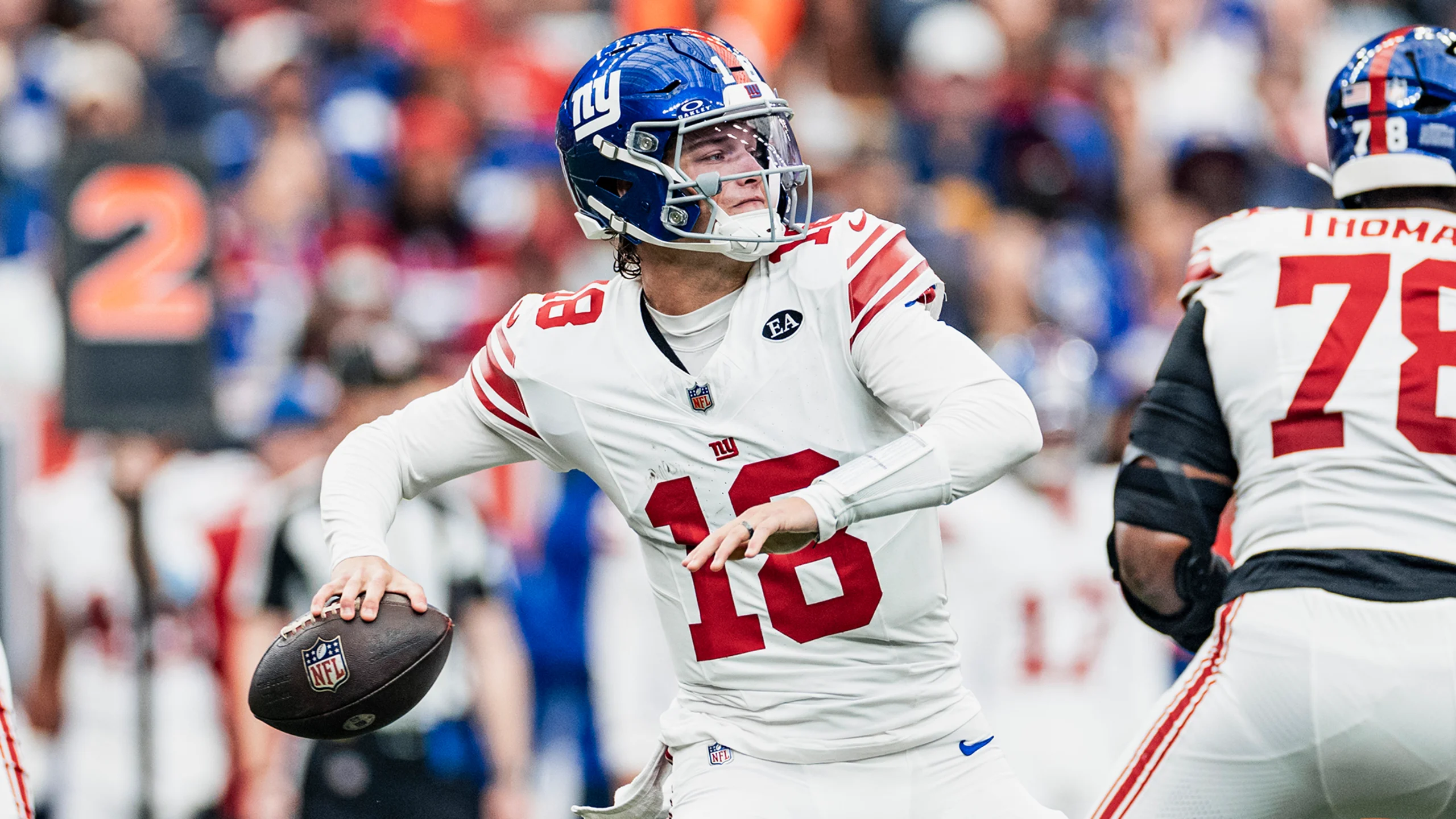
The loss of Jaxson Dart placed additional responsibility on J.J. McCarthy, who now must help guide an offense attempting to maintain its position in the NFC East. That assignment is challenging enough for any quarterback, but it becomes considerably more difficult when the running game cannot consistently produce manageable down-and-distance situations. Quarterbacks are most effective when an offense can operate with balance, allowing the play-caller to keep defenses uncertain about whether the next snap will produce a run, a short pass, or a deeper opportunity downfield.
Without that balance, opposing defensive coordinators can become increasingly aggressive. When defenses do not respect the possibility of a productive rushing play, they can devote more attention to coverage, disguise pressure packages, and attack the quarterback in obvious passing situations. Offensive linemen are forced to handle repeated pass-protection assignments, receivers must create separation against defenses expecting the throw, and the quarterback is left with fewer opportunities to exploit favorable matchups.
That is not an ideal environment for McCarthy, particularly as he continues adjusting to the responsibilities of leading New York’s offense. The Giants need to provide him with opportunities to operate within a manageable structure rather than repeatedly asking him to rescue possessions after ineffective rushing plays or negative-yardage situations. A reliable ground game would allow the offense to control the tempo, create favorable second- and third-down opportunities, and use play-action more effectively to challenge opposing defenses.
How the Running Game Protects McCarthy
The running game also has an important relationship with pass protection. When an offense consistently establishes the threat of running the football, defensive linemen cannot attack every snap with the same aggressive approach they might use in an obvious passing situation. Linebackers must remain disciplined against potential handoffs, while safeties have to account for the possibility of stepping forward to support the run. Those responsibilities can create hesitation, and even a brief delay can give a quarterback additional time to identify an open receiver.
For McCarthy, those advantages could prove extremely valuable. New York does not need him to carry the entire offense through the air every week, nor should the coaching staff place him in a position where every meaningful possession depends on difficult throws against defenses that know what is coming. The Giants need to create an environment in which their quarterback can make efficient decisions, distribute the football, and take advantage of opportunities created by a credible rushing attack.
The Offensive Line Must Share the Responsibility
That responsibility does not belong exclusively to the running backs. New York’s offensive line must improve its consistency at the point of attack, the coaching staff must establish a productive balance between running and passing, and the offense must execute with greater discipline. But adding another dependable back could have given Harbaugh and his staff more flexibility as they searched for solutions, particularly with injuries already placing additional demands on the roster.
Instead, McCarthy will have to continue working with the existing personnel while the coaching staff attempts to improve an area of the offense that has already shown its limitations.
The Giants Needed a Backfield That Could Control Games, Not Just Produce Highlights
One of the most important differences between an exciting running back and a dependable rushing attack is consistency. Explosive plays are valuable because they can change field position, create scoring opportunities, and force opposing defenses to adjust. But a team competing for a division championship also needs to be capable of gaining difficult yards when everyone in the stadium knows a running play is coming.
That is particularly important in the fourth quarter, when protecting a narrow lead often depends on the ability to keep the clock moving and prevent an opponent from getting another possession. A team that can consistently gain four or five yards on early downs gives itself the opportunity to sustain drives, control field position, and reduce the number of possessions available to the opposition. A team that repeatedly gains little or nothing on first down can find itself facing predictable passing situations, increasing the likelihood of a stalled drive and another opportunity for the opposing offense.
The Giants have already demonstrated how costly those stalled possessions can become. Against Philadelphia, New York’s defense was forced to deliver repeated stops because the offense could not consistently establish control. That formula worked because the defensive front produced one of its strongest performances of the season, but it is dangerous to assume the same level of defensive dominance will be available against every opponent.
Why Fourth-Quarter Execution Matters
As the season progresses, the Giants will encounter teams capable of adjusting their protection schemes, limiting pressure, and forcing New York to win games through offensive execution. In those situations, the ability to run the football will become increasingly important. A dependable rushing attack can prevent opponents from controlling the tempo, protect a quarterback from unnecessary pressure, and allow the Giants to remain competitive even when their defense is not producing sacks and turnovers at an extraordinary rate.
Skattebo and Tracy remain important parts of that equation, and both have the talent to contribute to a more productive offense. But expecting them to solve every problem without additional support places significant responsibility on players who are still developing within the system. The Giants needed to consider whether another experienced running back could provide a steadier rotation, improve situational execution, and give the coaching staff additional options when the offense struggled to establish momentum.
Standing Pat Left Harbaugh With the Same Offensive Questions
The Giants’ decision not to add a running back was not automatically a disastrous mistake. Running back production depends heavily on blocking, offensive design, and execution, and acquiring a veteran would not have guaranteed an immediate transformation. New York could have surrendered draft capital for a player who struggled behind the same offensive line or failed to provide the improvement the coaching staff expected. Schoen was right to consider those possibilities before committing organizational resources.
But there is also a cost associated with doing nothing, particularly when the weaknesses are already visible and the opportunity to compete is real. The Giants had enough evidence through eight games to understand that their rushing attack needed greater consistency, and their victory over Philadelphia only reinforced that concern. They were leading the division, their defense was performing at a high level, and their quarterback situation had become more complicated because of injury. Those circumstances made the need for offensive support more urgent, not less.
Harbaugh and his staff must now find solutions through improved execution, better blocking, more effective play-calling, and continued development from the players already on the roster. That is certainly possible, and the Giants have demonstrated enough resilience this season to suggest they are capable of making adjustments. However, the front office had an opportunity to make that process easier by acquiring another dependable contributor, and it failed to do so.
Harbaugh Must Find Answers Without Reinforcements
The frustration surrounding New York’s trade deadline should not be reduced to the failure to acquire Jonathan Taylor. Taylor would have represented a significant addition, but the Giants did not need a superstar to improve their running game. They needed greater reliability, more flexibility, and a backfield capable of helping the offense control games rather than repeatedly depending on the defense to protect narrow leads.
Schoen chose to preserve the organization’s remaining resources, and that decision may prove valuable in future seasons. But the Giants are not simply building toward some distant opportunity anymore. They are leading the NFC East, competing for a division championship, and trying to turn an unexpectedly promising season into something meaningful. Their success has created expectations, and those expectations make unresolved offensive weaknesses more difficult to overlook.
New York has two talented running backs in Cam Skattebo and Tyrone Tracy Jr., but talent alone does not guarantee a productive rushing attack. The Giants needed a running game capable of taking pressure off J.J. McCarthy, sustaining possessions, and giving their defense a chance to recover. By standing pat, the front office left Harbaugh with the same personnel and the same responsibility to find answers that should have been a priority before the deadline ever arrived.
A Pre-Deadline Move That Could Have Long-Term Implications
Although the New York Giants failed to make a move on November 10, evaluating Joe Schoen’s trade deadline strategy requires looking beyond the transactions that never materialized. The organization’s decision to acquire quarterback J.J. McCarthy from the Minnesota Vikings on September 28 was an important personnel move that deserves consideration when assessing how the front office approached the 2026 season. While much of the attention surrounding the deadline centered on New York’s unsuccessful pursuit of Indianapolis Colts running back Jonathan Taylor, the earlier McCarthy acquisition represented a different kind of investment, one designed to provide immediate insurance at football’s most important position while potentially strengthening the franchise’s long-term outlook.
The Giants acquired McCarthy in exchange for a 2027 fifth-round draft selection, a relatively modest price for a young quarterback with starting experience and the developmental potential that made him an attractive prospect coming out of Michigan. Quarterbacks with his background rarely become available without significant questions surrounding their future, but acquiring one without surrendering premium draft capital created an opportunity for New York to evaluate a player who could eventually provide value well beyond the original cost of the transaction.
An Investment That Became More Than Quarterback Depth
At the time, the move could reasonably be viewed as an investment in depth and competition rather than a declaration that the Giants were abandoning their commitment to Jaxson Dart. New York still considered Dart an important part of its long-term plans, but the physical demands of the NFL make quarterback depth more than a luxury. A team can spend an entire offseason developing an offensive system around one player, only to have an injury force the coaching staff to reconsider everything from protection schemes to passing concepts and game-management responsibilities. By acquiring McCarthy, Schoen gave the organization another option capable of competing within that environment while preserving the opportunity to develop a young quarterback whose career was far from complete.
McCarthy’s Acquisition Became More Important as the Season Unfolded
The significance of the McCarthy trade became considerably greater once injuries disrupted New York’s quarterback situation. Dart’s season-ending absence created a challenge that extended beyond replacing the starting quarterback on the depth chart. The Giants were suddenly asking their offense to maintain its competitiveness while adjusting to a different player under center, a task made more difficult by an inconsistent rushing attack and a roster already dealing with significant injuries at other positions.
For McCarthy, the opportunity came with considerable responsibility. Joining a new organization requires learning unfamiliar terminology, developing chemistry with receivers, understanding protection responsibilities, and building trust with an offensive coaching staff. Those challenges become even more demanding when the team is competing for a division championship and every possession carries greater significance. Unlike a quarterback joining a rebuilding organization with the freedom to develop through mistakes, McCarthy entered a situation where New York needed productive football immediately.
That pressure makes the earlier acquisition particularly important. Had Schoen waited until the Giants were forced to address an emergency at quarterback, the organization might have found itself negotiating from a position of desperation. Other teams would have understood New York’s circumstances, potentially increasing the cost of acquiring a player capable of contributing. By completing the McCarthy trade before that situation developed, the Giants secured another quarterback option without having to surrender the kind of compensation that can complicate future roster construction.
Why the Early Acquisition Helped the Coaching Staff
The move also provided Harbaugh and his offensive staff with an opportunity to work with McCarthy before the season reached its most demanding stretch. Even when a quarterback is not immediately expected to start, time spent learning the playbook, participating in meetings, and developing familiarity with teammates can become valuable when circumstances change. The Giants now have a player who has had an opportunity to begin adjusting to the organization rather than someone forced to arrive in the middle of a crisis with little preparation.
That does not guarantee McCarthy will become the answer to New York’s offensive problems, nor should the front office receive unconditional praise before his performance justifies it. But the trade provided the Giants with an additional option at a critical position, and the value of that decision became more apparent as the season progressed.
The Price of the Trade Was Part of Its Appeal
One of the strongest arguments in favor of the McCarthy acquisition is the compensation New York surrendered to complete it. A fifth-round draft selection carries legitimate value, particularly for an organization attempting to build a sustainable roster through the draft. However, the opportunity to acquire a young quarterback with starting experience for that price presented a risk-reward calculation that was considerably different from the potential cost of acquiring an established star at another position.
The Giants were reportedly interested in Jonathan Taylor because he could have provided an immediate upgrade to their rushing attack. Taylor’s production, experience, and ability to influence opposing defensive schemes made him an appealing target for a team struggling to establish offensive consistency. But acquiring a player of his caliber would have required a significantly different investment, potentially involving valuable draft selections and additional financial considerations.
That distinction helps explain why the McCarthy trade was easier to justify from a long-term roster-building perspective. New York surrendered a mid-round selection for a player at the most valuable position in football, with the possibility of receiving meaningful production at a relatively manageable acquisition cost. If McCarthy develops into a dependable contributor, the Giants could receive value far exceeding what they surrendered. Even if he does not ultimately become a long-term starter, the organization may still benefit from having a capable quarterback who can provide competition, depth, and flexibility.
The Difference Between Value and Overpaying
The same reasoning does not automatically apply to a veteran running back, particularly one whose acquisition would require significantly greater compensation. Running backs can make an enormous difference to an offense, and Taylor certainly possesses the talent to influence games. However, the physical demands of the position, the importance of offensive line performance, and the financial considerations associated with established veterans create a different set of risks.
Schoen had to determine whether the immediate benefits of acquiring Taylor justified those costs, particularly when the Giants had other weaknesses that needed attention. The McCarthy trade demonstrated that the front office was willing to invest in a player when it believed the price offered favorable value. The unsuccessful pursuit of Taylor, meanwhile, illustrated the limits of what New York was prepared to surrender for a more expensive offensive addition.
A Valuable Investment Does Not Erase the Giants’ Other Needs
The McCarthy acquisition deserves recognition, but it should not become an excuse for the Giants’ failure to improve elsewhere. New York entered the deadline with identifiable weaknesses at running back and defensive tackle, and those concerns remained unresolved when trading concluded. Acquiring a young quarterback in September was a reasonable decision, but it did not strengthen the defensive interior or provide the offense with a more dependable rushing attack.
That distinction is important when evaluating Schoen’s overall performance. General managers should receive credit for successful acquisitions, but one promising transaction does not eliminate responsibility for other roster deficiencies. The Giants’ ability to compete for the NFC East has been built on Harbaugh’s leadership, defensive resilience, and the willingness of players to overcome adversity. Those accomplishments created an opportunity for the front office to strengthen the roster before the most important stretch of the season.
Instead, New York found itself attempting to balance the value of earlier investments against the cost of additional acquisitions. The fifth-round selection surrendered for McCarthy was no longer available, just as the fourth-round selection used in the move for Malachi Fields had already been committed. Those decisions may ultimately produce meaningful returns, but they also reduced the draft capital available when Schoen began exploring potential deadline additions.
That is the complicated reality of NFL roster construction. A general manager can make a defensible trade in September and still find himself wishing he had retained additional flexibility in November. McCarthy may eventually justify the price New York paid to acquire him, but that does not change the fact that the Giants entered the deadline with fewer assets available to address other weaknesses.
McCarthy’s Long-Term Value Could Extend Beyond the 2026 Season
The most intriguing aspect of the McCarthy trade is that its ultimate value may not be determined by what happens during the remainder of the current season. While the Giants need him to help keep the offense competitive now, the organization also acquired a young quarterback whose future could develop in several different directions.
If McCarthy establishes himself as a dependable starter, New York will have acquired a potentially valuable player at a position where teams routinely surrender substantial draft capital in search of stability. If Dart returns and reclaims the starting role, McCarthy could still provide important depth and competition, allowing the Giants to maintain a stronger quarterback room than they otherwise might have possessed.
There is also the possibility that McCarthy’s development could create future trade value. Quarterback demand remains high throughout the NFL, and teams frequently search for young players with starting experience who may benefit from a different opportunity. If McCarthy demonstrates improvement and attracts interest from other organizations, the Giants could eventually find themselves in a position to recover some of their investment or potentially acquire compensation exceeding the fifth-round selection they surrendered.
Of course, those outcomes remain possibilities rather than guarantees. McCarthy still has to demonstrate that he can operate New York’s offense effectively, make sound decisions under pressure, and develop the consistency required of an NFL quarterback. The Giants cannot assume that his draft pedigree or previous experience will automatically translate into success, particularly with the offensive challenges that remain unresolved.
Nevertheless, acquiring a player with multiple potential paths to providing value is generally a sound approach when the compensation is reasonable. That is what makes the McCarthy transaction one of the more defensible decisions Schoen has made during the 2026 season.
A Smart September Trade Does Not Automatically Make November a Success
The Giants’ decision to acquire McCarthy demonstrated that Schoen was capable of identifying an opportunity and completing a transaction without sacrificing the organization’s most valuable assets. It was a move that addressed quarterback depth, created developmental possibilities, and provided additional protection against the injuries that can disrupt an NFL season.
But the standard for evaluating a general manager cannot be limited to whether individual transactions appear reasonable. The larger question is whether those decisions collectively place the team in the best possible position to compete. New York’s acquisition of McCarthy may prove valuable, yet the Giants still entered the trade deadline needing help at positions that could influence their ability to win the NFC East.
The unsuccessful pursuit of Taylor illustrated the challenge of balancing immediate improvement against long-term investment. Schoen was right to avoid surrendering unreasonable compensation simply to make a high-profile acquisition, but the Giants also needed to explore whether more affordable alternatives could strengthen their running game. The same principle applied to defensive tackle, where the organization failed to add another dependable interior presence despite a clear need to improve against the run.
For Bad Dawg Sports, the McCarthy trade deserves to be viewed as a potentially strong personnel decision rather than evidence that the Giants enjoyed a successful deadline. Those are two different evaluations, and both matter when considering how Schoen managed the roster.
Why the September Move Cannot Excuse November’s Inaction
New York may eventually look back on the acquisition of J.J. McCarthy as one of its better investments, particularly if he develops into a reliable quarterback or creates additional value for the organization. But that possibility does not erase the immediate concerns surrounding the running game, defensive interior, and overall depth of a team trying to win its division.
The Giants made a calculated investment in September and chose restraint in November. Whether that combination proves successful will depend on how McCarthy develops, how effectively Harbaugh addresses the offense’s limitations, and whether New York’s defense can continue overcoming the weaknesses that remain along the interior.
Schoen may have found genuine value in McCarthy, but the Giants’ championship opportunity is unfolding right now. The front office must ultimately be judged not only by the players it successfully acquired but also by whether it did enough to support a first-place team when the chance to strengthen it was still available.
Bad Dawg Sports Analysis: The Offensive Adjustment That Cannot Wait
The Giants do not need a spectacular run on every possession. They need fewer wasted early downs, better blocking at the point of attack, and a rushing threat that forces defenses to respect play action. Skattebo and Tracy can contribute in different ways, but Harbaugh must create a more dependable rhythm for McCarthy instead of asking the quarterback to overcome predictable long-yardage situations.
The failed Taylor pursuit should be judged against the actual football problem it was meant to solve. The question is not whether New York missed the biggest name on the market; it is whether the offense can become more balanced without him. For the front-office verdict, see our Good, Bad, and Ugly deadline grades.
Analysis and grades are Bad Dawg Sports editorial assessments.
Discover more from Bad Dawg Media Group
Subscribe to get the latest posts sent to your email.


